Definition
Cinematography, also known as the art and technology of cinematographic photography, is a process that involves different techniques such as the general composition of a scene; the illumination of the whole or the location; the correct selection of cameras, lenses, filters and films; the appropriate angle to use in the camera and movements, as well as the integration of special effects.
These aspects mentioned in the area of cinematography can involve an important team when we refer to a feature film, which is guided by the photography director, first cameraman and the director of photography, who must achieve that the images and photographic effects are what the director really needs. The concept of cinematography itself can also refer to the technique by which films are created to represent stories.
Cinematography characteristics
Among the main characteristics we can mention the following:
- It is a relatively modern invention because it was until the twentieth century that began to create films the way we know them today.
- The images are placed together and projected in a continuous way to produce an idea of movement.
- It can be used in the area of photography, montage or projection.
- It is also known as cinema, technique and the art of capturing, storing and retransmitting moving images equipped with an audio support.
- It is carried out with a video camera and is related to photography, both technically and creatively.
- All the recording that is made through cinematography is a montage.
Origin
The origin of the cinematograph is actually quite old and dates back to 1654 when the German priest Atanasio Kircher made a series of experiments with moving images using his interesting magic lantern. A century later, the well-known Fantasmagories of the Frenchman Gaspard Robert, who was known as “Robertson” were created, which was a spectacle based on figures painted on glass plates.
History
In 1833, the Austrian mathematician Simon von Stampfer had formed an interesting artifact which he called a stroboscope, with which he could perceive an object that spun on itself giving the idea that it spun very slowly. With the invention of photography, the cinema developed little by little. In 1874 the French astronomer Jules Janssen devised his “photographic revolver“, considered the ancestor of today’s camera.
The history of cinematography begins on December 28, 1895 with the participation of the Lumière brothers, who at that precise moment showed the first public projection in which images that were in motion could be shown and they did so through their new invention, the cinematograph. Thomas Edison had also done the same with his kinetoscope, with the difference that the cinematograph was much lighter and more functional, and in addition to capturing moving images, he could also project them.
Thomas Alva Edison in 1889 invented the kinetograph which was the first sound camera in which he placed the axis of the camera shutter with a phonograph, managing to record sound and image at the same time. It was Edison who invented sound cinema in 1902, but the sound was so weak that it was not practical. In 1910, Leon Gaumont with the chronophone began to study the possibilities of creating sound cinema. From the first works that are observed today, cinematography has had a process by which it has become a huge industry that moves billions around the world.
Elements of cinematography
The elements of cinematography are the following:
- Frame: the composition that contains the image that arises from the selection of the elements are captured by the camera and a coherent image is projected on the screen. An idea can be expressed through framing.
- Flat: this is the part of reality that adapts to the camera Its size is used to accentuate the dramatic or narrative content within the film.
- Angle: is the position that the camera is placed in front of the character to obtain a psychological or narrative
- Camera movement: it is one of the main elements of language.
- Travelling: when the camera moves but maintains its optical axis and angle of shot.
- Panoramic: the camera rotates on its own axis to resemble the subjective perspective of a certain character.
- Trajectory: the camera must follow the trajectory of a character or situation.
Techniques
Some of the most used techniques in cinematography are the following:
- Motion blur: known as motion blus, is a technique that consists of the moving trace of an object that when recorded or photographed changes its position in the capture.
- Fisheye effect: the image is recreated resulting in a distortion that resembles the reflection produced in a sphere.
- Reflection in the lens: it is a technique that consists of recreating brightness points, which arise when the light is reflected is captured by a camera.
- Forced perspective: when we place the objects that have been captured in a specific way between them, obtaining a forced perspective.
- Subjective plane: in this plane, the action shown on the screen is shown from a front page
Staff
The staff participating in the cinematography is as follows:
- Director of photography who is also called cinematographer.
- A camera operator who is known as a cameraman.
- First camera assistant also known as focus man.
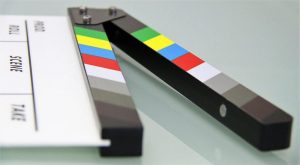
- Second assistant cameraman also known as claquetist.
Importance of cinematography
Cinematography is important for human beings because it is a way of expressing art with the aim of creating entertainment for both adults and children. It is one of the most important industries that exist today, a mechanism that promotes creativity and the development of the ability to represent a particular idea. It is also important at the technological level because it promotes the development of the same in search of new tools to improve images.
Examples
Some examples of cinematography are the following:
- Comercial Cinema
- Independent Cinema
- Animated Cinema
- Documentary Cinema
- Experimental cinema
- Authors’ Cinema