Characteristics of pop art
Among the main pop art characteristics we can mention the following:
- There was a rejection of abstract expressionism.
- They tried to put art in contact with the world and with reality.
- It used a figurative and at the same time realistic language to express the different cultures and ideas of the contemporary world.
- His main themes were taken from cities, social aspects, magazines, comics, cinema, radio and television.
 It was an art that did not have any kind of critical thinking.
- The subjects that were represented were conceived as motives that justified the existence of painting.
- The language was figurative and represented real objects.
- It represented the inexpressive character, in a frontal way and in many occasions in a repetitive way.
- It mixed painting with some real objects within the same work.
- He had preferences for social classes, fame and violence. He focused a lot on sex and eroticism.
- The forms that were represented were made in natural scales and in some occasions extended.
History of pop art
Pop art was born in England in the decade of the years 50´s. It was born from thoughts and reactions of different artists that went against abstract expressionism, since for them, it was neither normal nor common in people. The term “Pop Art” was initially given by the British critic Lawrence Alloway, who, in 1958, referred to popular art in his essay The Arts and the Mass Media. However, the movement itself was born in London, England, through a work by Richard Hamilton called “What Makes Today’s Homes So Different, So Funny,” a collage considered the first work of pop art.
Importance
Through pop art, artists are able to represent different public art figures that are or have been most representative for a nation, and from this, messages are created addressed to nations through different everyday elements creating links between people and works. It looks for the way to approach the emblematic elements of a country.
Architecture
Their forms have freedom and are full of color looking for the way to reflect stridency with sense and spontaneity. Basically, we cannot speak of a pop art architecture, but several buildings have taken examples of its strokes and colors.
Sculpture
The process of the sculptures is manual and totally handmade, by means of molds in which fiberglass is placed, and then color is added. Sculpture sources are based on the daily reality of the moment, of the mass culture that is born from the reproduction industry. Simple and recognizable images are sought and taken to the category of art.
Paint
The colors used in pop art are generally quite bright, pure and without a lot of nuances, we could say flat. Mainly acrylic paint is used.
Representatives of pop art
- Richard Hamilton: Pioneers of British Pop Art, creator of the collage entitled What Makes Today’s Homes So Different So Funny? He criticized the consumer society, eroticism, advertising and technology that caused an empty society.
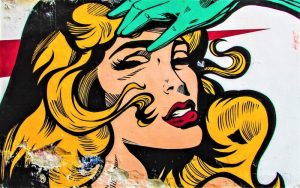
- Roy Lichtenstein: His compositions are based on comic strips, with cartoons, knitting techniques and bright primary colors.
- Tom Wesselmann: He became interested in issues related to sensuality and the woman was seen by him as a consumer object. He worked on montages where he incorporated real objects and recreated bourgeois spaces.
- Andy Warhol: He worked with contemporary press photographs and repeated them multiple times on the same surface. He described the dehumanization practiced by modern mass media.
Examples of outstanding pop art works
Some examples of pop art that have been recognized worldwide are the following:
- The cans of Campbell’s soup, which represents American consumerism.
- Marilyn’s diptych, by Andy Warhol, was a Marilyn Monroe series of photographs in which one part is in color and the other fades to black and white.
- Whaam! By Roy Lichtenstein, which refers to the image of a modern American hero.
- Girls drowning in Roy Lichtenstein, which referred to broken hearts.
- I was a rich man’s toy by Eduardo Paolozzi, made from images of ex-military men that had been published in different magazines, to refer to culture, technology and glamour.