Characteristics
The main characteristics of the magic lantern were as follows:
- It was one of the most important projectors in the world of cinema.
- It had the ability to project small images that were painted on glass sheets.
- It was widely used in schools and colleges.
- It had a box with lenses.
- It was considered by many to be a device that could work magic.
- During the presentations with the magic lantern, musicians and presenters were invited to animate the presentation being made.
- It was widely used in phantasmagoria, which was a way of doing horror theater, mainly ghosts.
How the magic lantern works
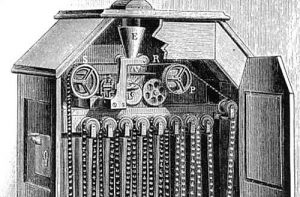
The device works through a dark camera that has several lenses and a mobile support in which a previously painted glass plate is fixed. The image was illuminated by an oil lamp. It also had a smoke outlet at the top so that, the image would not lose its brightness.
Depending on the projection angle, the flashlight compositions may vary, as well as the parts that compose it, which are: panoramas, multi-lens and dioramas. Depending on the amount of light and if color transparencies are applied, one could see the same landscape in different situations. This visual illusion was considered magical.
In the mid-sixteenth century, Caglioro placed a set of wheels on the lenses to enlarge and reduce the size of the images. The invention of the Argand lamp, in 1790, the calcium light in 1820 and in 1860 with incandescent lamps replaced the light source, reducing the size of the lantern and enhancing the brightness and sharpness of the projected image.
Who invented it
The magic lantern was invented in 1600, and is believed to have been invented by Christiaan Huygens, a Dutch scientist. The inventor was known as the true inventor in 1671, approximately 12 years after he invented it. Previously, Athanasius Kircher was considered its inventor.
History
It was the most ancient way of projecting slides and has a long and fascinating history. The first magic lamps were illuminated by candles, but as technology evolved, they were illuminated by more powerful means.
The name “magic lantern” comes from the experience of the first audiences who saw devils and angels mysteriously appear on the wall, as if by magic. Even in the earliest period, the representations contained moving images created with moving glass pieces.
In the 18th century, the lantern was a common form of entertainment and was also used in the field of education in Europe. The “lantern show” was the oldest known show in the U.S., and was held in Salem, Massachusetts, on December 3, 1743, as an entertainment form. But the lantern light source in this period was still weak, and as a consequence, the audience was small.
In the mid-19th century, two new forms of lighting were developed, one known as “Limelight” which was created by heating a piece of limestone in fiery gas until it became incandescent. It was dangerous, but it produced a light that was strong enough to project an image before thousands of people, giving rise to great spectacles. Kerosene lamps were not so bright, but they were so safe that they could be used by children, which resulted in widespread use in churches, schools, fraternal societies, and toy lanterns. In the 20th century, electric lighting was introduced, which extended the lantern even further.
How to make a homemade magic lantern
The steps to make a homemade magic lantern are as follows:
- A camera lens or magnifying glass to read. This lens should be fitted with a black paper with a central hole of about 24 mm in diameter.
- If you have a camera with a lens, you only have to place the camera in front of the projector.
- Leave the shutter open and remove the back so that the light can pass through the camera.
- Place the lens and attach it to a tube approximately 7 cm long. This tube can be made of cardboard.
- Secure the lens to the inside of the tube.
- Prepare the box for the magic lantern, which must be made of cardboard or wood. One side of the box must be open, and the opposite side has a circle equivalent to the cardboard tube.
- Above the box, in the light line, three or four one-and-a-half centimeter holes are opened for ventilation and to prevent the postcards from being damaged by excessive heat. The holes should be covered with metal or wood to prevent the escape of light.
- Paint the entire box with black paint.