Characteristics of Gothic art
Gothic art managed to transform castles, churches, cathedrals in almost all of Europe through its characteristics, among them we can mention:
- The buildings were very high, so they swept upwards with height and grace.
- One of the fundamental characteristics of Gothic architecture was its height. New building techniques allowed architects to extend the walls to make them taller as with towers.
- The flying buttress is the most important and defining characteristic of Gothic architecture. These buttresses act to separate the walls from the weight. They support the structure by transferring the force directly to the floor.
- Innovation and construction of the pointed arch were another key feature of Gothic architecture. Its meaning was practical and merely decorative.
- The Gothic arch had an aesthetic value and great beauty that influenced many other features of Gothic design, especially the vaulted ceiling.
- The vaulted and irregular ceilings used pointed arch technology to separate the strength and weight of the upper floors.
- It had temporal sequence and was an art focused on religious aspect.
- Imposing and important cathedrals were built.
Origin of Gothic art
Gothic art is an artistic style that was born in Western Europe at the end of the Middle Ages. It began in the 12th century and lasted until the arrival of the Renaissance in the 15th century. The greatest number of expressions of Gothic art occurred in northern France and then spread throughout the West.
Historical context
Gothic art developed over a long period in which European culture underwent profound changes that influenced art. In the 11th and 12th centuries, the countryside was more productive, and trade had re-emerged. Cities began to recover, and in the Gothic era, a new social group emerged, the bourgeoisie, which increased its protagonist. Civil buildings, palaces and, above all, cathedrals were built as a symbol of the new urban pride. Interest in earthly things, pleasure, the art refinement re-emerged, and the modern spirit began to be forged along with a religious view of the world. Money became more important, and men emerged who turned poverty into virtue.
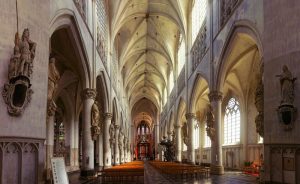
The Latin cross plants predominated, distinguishing the chancel, the transept and the naves. The chancel had an ambulatory and radial chapels and the central nave, and the transept were wider. A lot of value was given to building façades, where towers and doors were placed. The façades were H-shaped. Buildings come to life and become spontaneous using an engineering empiricism to create high, colorful spaces.
Religiousness was centered on imitating Christ. Capitalism and urban life progressed, and several plague epidemics reduced the population of some cities decreasing the economy. The socio–political situations surrounding Gothic art caused social stability to be much greater from the mid-12th century onwards as national powers, monarchies, and feudal lords were finally controlled by royal power.
This stability produced economic development, more trade and market and human development. Importance was given to agriculture and commerce, handicrafts, and bourgeoisie that emerged as a new social group. The new form of society, more citizen and richer was dominated by a religious spirit as profound as it was different from that of previous centuries. The official and Christian society had triumphed, and God’s law was its foundation.
Importance of Gothic art
The importance of Gothic art is based mainly on the influence it managed to exert in modern times and the legacy it left in society. The buildings that have been built and that remain to this day are the basis of art. It helped to revive interest in medieval buildings and many buildings were rebuilt. Music and ideas are preserved to this day, and many philosophical and religious beliefs contributed techniques and knowledge.
Architecture
Sculpture
The most commonly used materials were stone, polychromed wood, ivory and metal. Naturalism predominated in sculpture and humanizing sculptures was sought, seeking to reach the bodies volumes, movement and feeling expression through faces and attitudes. Its composition was quite orderly and organized in registers, sculptors were mainly concerned with depth and details. The main theme was the religious aspects, although there were also some profane themes.
Paint
As for painting, they used techniques such as tempera and oil, they painted on boards and made different mural paintings. For them, drawing was very important because it was responsible for delimiting the different forms, to mark models and to create compositional rhythms. Light was an important element to highlight volume. Colors were key elements, and different ternary ranges were used to fill all the symbols with great color.
Representatives of Gothic art
- Jan van Eyck
- Simone Martini
- Roger Van Der Weyden
- Robert Campin
Examples of outstanding works
- Burgos Cathedral
- León Cathedral
- Toledo Cathedral
- Milan Cathedral
- Stained-glass windows of the Cathedral of León
- Reims Cathedral
- Notre Dame Cathedral