Exosphere characteristics
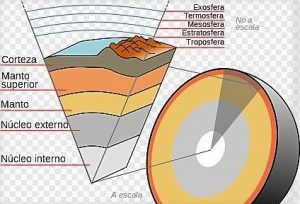
- It is the least dense layer of the Earth’s atmosphere. It is located above the thermosphere and is in contact with outer space: that is why scientists refer to it as a transit point between the atmosphere and interplanetary space.
- Some gases found in this layer can escape and go to outer space because of the small amount of gravity that is in it. These gases usually diffuse in a vacuum.
- Heat cannot be transferred in this layer because it has very few particles due to the very high air density. The temperature is closely related to the average speed of the atoms and molecules of a gas: the higher the speed of the particles, the higher the temperature.
- Particles in the exosphere have the ability to move very quickly.
- It orbits many artificial satellites, mainly meteorological
- In this layer, atmospheric gases such as oxygen and nitrogen are practically absent, and we can hardly observe the existence of some particles of matter.
- The bodies present in the exosphere can be heated if they are illuminated by a large amount of solar rays.
- It is located at an altitude of 530 kilometers from sea level, and in it atmospheric gases such as oxygen and nitrogen are non-existent.
- It is the largest layer of the entire atmosphere, it is the area most inspected by artificial satellites and this layer has no influence on meteorological events.
Composition of the exosphere
The exosphere is made up of pure plasma material, and in it, particle ionization establishes whether the attraction of the terrestrial magnetic force is higher than that of the gravitational force, which is why it is sometimes also called the Magnetosphere. In it, particles of the lightest gases contain an average velocity, allowing each gas to migrate towards interplanetary space, preventing the Earth’s gravitational power from being able to retain them. The structure of the exosphere is formed primarily by light gases such as hydrogen, carbon dioxide, atomic oxygen and helium. All of the above-mentioned gases are so light that they have the ability to escape the Earth’s gravitational magnetic force, spreading freely around space.
Function of the exosphere
The function of the exosphere is to act as a transition medium to a zone without gases or apparent gravity, and also helps atoms to escape from the atmosphere to outer space.
Temperature
Scientists through their research use to measure the temperature in the exosphere the average speed of the molecules or atoms of a gas. When these particles move very quickly, the temperature of this layer becomes very hot. When the particles move more slowly, the temperature is cooler. However, the particles in it move very fast, so the temperature is quite hot.
Importance
The exosphere is an important atmospheric layer as it functions as a transition zone between the earth’s atmosphere and outer space. In addition, it is the layer in which we can find artificial satellites that carry out constant studies of the earth and outer space. It also acts as a transit zone towards outer space.