Characteristics of zooplankton
Some of its most relevant characteristics are the following:
- They are able to live in both fresh and salt water.
- They are bad swimmers.
- It reproduces asexually through a process called bipartition.
- Juvenile fish are part of zooplankton.
- They move up and down in the water.
- They look for water surface during the night to get food.
- They stay in deeper water to get away from the sun during the day.
- It is classified by size and stage of development.
- It is made up of secondary and tertiary producers.
- Freshwater zooplankton consists mainly of protozoa, single-celled animals and some crustaceans.
- When they die, their shells fall and settle to the bottom of the sea.
- The majority is located in the North Atlantic and the greatest diversity in the Pacific Ocean.
- Zooplankton known as “krill” is whales’ favorite food and lives in cold water.
Types of zooplankton
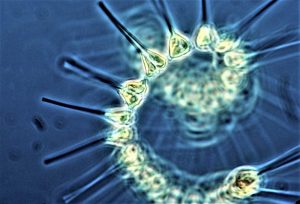
Zooplankton can be divided into two different types of animals: holoplankton, which are those that spend their life cycle within the plankton; and meroplankton, which includes eggs, larvae and small fish that are in their early life stage. It is classified depending on its size, this way, we have the following classification:
- Protozooplankton is also part of the microplankton and the organisms that compose it are classified according to the locomotion system that they present, we can find the following organisms:
- Zoomastiginos: they move through flagella and are normally known as flagellated zoo.
- Sarcodines: move by means of pseudopods and among them we find the phylum rhizopoda, phoraminiphera and actinoid.
- Ciliophoran: they move using cilia, such as suctoria, hotricos and spirotricos.
- Metazooplankton: is part of mesoplankton, macroplankton and mega plankton. In this category there is also a subclassification that includes holoplankton and meroplankton.
- Holoplankton: live in plankton and can be gelatinous like mollusks and cords or can be chitinous like annelids and arthropods.
- Meroplankton: a part of their life is inhabited in plankton.
According to their size, they can be classified into:
- Picoplankton: less than 2 micrometers
- Nanoplankton: from 2 to 20 micrometers
- Microplankton: 20 to 200 micrometers
- Mesoplankton: 200 micrometers to 20 millimeters
- Macroplankton: 20 to 200 mm
- Mega plankton: more than 200 millimeters
Zooplankton feeding
Phytoplankton obtains its energy and food directly from the sun through the process known as photosynthesis, and they do so in the same way as plants do. Zooplankton feeds on phytoplankton and small organisms such as diatoms and other protozoa and is then consumed by larger zooplankton that includes animals such as fish, but larger in size. Plankton is at the base of a complex aquatic food web. It is important to mention that zooplankton is located at the bottom of the oceanic food chain and outside the oceanic food net. That means that many creatures eat them.
Representative species
Some of the most representative species are listed below:
- Talitrus jumper
- Asellus aquaticus
- Salmon louse
- Exotic Ligia
- Armadillidium vulgare
- Krill
- Peaceful Euphrasia
- Arubolana imitates
- Aequorea victory
Usage of zooplankton
The use and the different studies regarding zooplankton leaves us as a teaching that they have many good practical utilities for human being. For example, saline Artemia, which is a type of crustacean brachiopod belonging to zooplankton, which is used in aquaculture and aquatics to feed with one of the best diets, young and small fish. Franciscan Artemia is distributed in the form of cysts that have to be hatched in order to develop and be used as live food directly.
Importance
On the other hand, one of the most important features of zooplankton is that it contains krill. This is a type of malacostraceous crustacean that in addition to be the principal whales food, has been cultivated and consumed as human food in Japan. At present, it can be found as krill oil, which is very rich in omega-3 acids. It can also be used in various types of industrial applications as they are extracted chitin or chitosan that has multiple industrial applications, food and pharmaceutical.