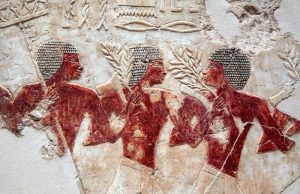
Roman art characteristics
To the Greek influence are added novelties such as the use of new materials, different construction systems and modifications in architectural orders with a tendency towards the colossal due to its large buildings. It is possible to emphasize the practical and/or utilitarian aspects of their works, as well as their decorative purpose. In techniques such as sculpture, perfection and similarity Roman Art was similar to Greek culture, due to realism predominance and human figures with narrative character.
Chronological history of Rome
It could be distinguished in three periods:
Monarchy: 753 B.C. to 510 B.C.
- It is estimated that the foundation of Rome occurred approximately in 753 B.C.
- In 509 B.C., the Romans expelled the Etruscans and thus made the monarchy a republic.
Republic: 510 B.C. to 27 B.C.
- After the dethronement of Tarquino kings (500 B.C.), the Roman Republic was founded.
- Approximately in 450 B.C. Romans colonized Italy.
- The conquest of the Greek state of Egypt by Rome (300 B.C. Approx.)
- Birth of the Roman Empire. (27 B.C.)
Empire: 27a.C. to 476 A.D.
- Birth of Jesus.
- Birth of the Empire thanks to Augustus (Octavian)
- Construction of the forum and mausoleum of Augustus.
- The decadence of Rome (around the 3rd century A.D.)
Roman architecture
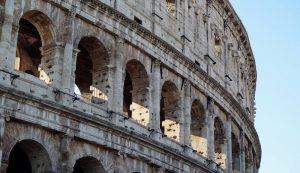 It was distinguished by a civil character based on the curved line, in which technical novelties were introduced such as the arch, the vault and the use of domes.
It has a strong influence of Greek origin, in which novelties are introduced such as: the Tuscan column, capital similar to the Doric, smooth shaft and supported on a base; the use of the composite order, Corinthian capital with the volutes of the Ionian; and the use of a kind of concrete or mortar based on sand and pebbles.
The architecture acquires public predominance in society and urbanism, in which they stand out:
- Temples: They were characterized by having a similarity to a façade-building and by having an elevated base from which it was possible to arrive by staircase. Contrary to the Greek temples, the Tuscan order was used in the early times and later in the Corinthian order. Example: The Temple of Nîmes (France).
- The forum: Acquires a monumental character after the 1st century B.C. due to the fact that daily life becomes more complex and because of social aspects, because a place for meetings was required. Each city had a forum and a central square, where statues of famous politicians and emperors were exhibited. Example: Pompeii Forum.
- The Basilica: Its utility was intended for administrative functions or merchant meetings. It was characterized by its rectangular shape. Its importance is seen in the future with Christian art. Example: Basilica of Maxentius.
- Thermal baths: They were social centers, which were divided into three large bathrooms, massage rooms, changing rooms and gardens. Example: The thermal baths of Trajan, Caracalla and Diocletian.
- The theater: Building with Greek similarity which is adapted to their needs. The Romans vary their construction by vaulting the galleries. Example: Liptis Magna Theatre (Libya).
- The amphitheaters: Another construction of monumental character which was made up by an elliptical plant, it was divided in: the grandstand for the public, the sand for the spectacle and a set of underground galleries under the sand and the grandstand, for the beasts, fighters, etc.
- The triumphal arches: Initially they were used to commemorate victories and later, they were seen in all city entrances.
Roman art painting
The few paintings that have been known represent a utilitarian character in which it is used to decorate building walls, using the fresco technique. Therefore, they are kept in buildings and ruins. The mosaic stands out as a representative technique, with geometric and animalistic motifs; where it was looked to represent daily life themes or mythology. The perspective was used to give a sensation of depth and chiaroscuro was used to represent volumes and expressions.
In the fresco it was common to see colors such as yellows, reds and oranges representing mythological and historical themes.
The mosaic was made with tesserae (small-sized stones) of different colors, as well as geometric, animalistic and human figures.
Sculpture in Roman art
As in painting, sculpture was influenced by Greek culture, where materials were marble and bronze. The presence of the bust or portrait predominates with enough expressiveness, almost always serene or sad. In the background is the presence of narrative reliefs in which warrior values and triumphs over enemies and the human figure were exalted over any other decorative element.