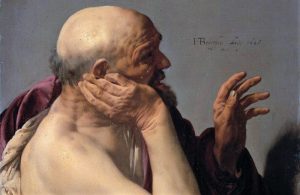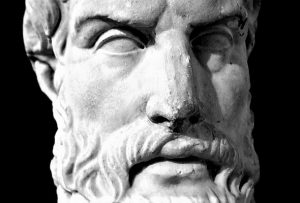
Biography of Plutarch
Plutarch was born into an aristocratic family in the city of Queronea in the region of Beocia, between 45 and 50 AD. The exact year of his birth is unknown, everything about his biography is because it is reflected in some of his most outstanding works, such as the name of his great-grandfather Nicarco when he relates the consequences left of the battle of Accio, his grandfather, Lamprias who makes reference in the talks after dinner and his own father, Autobulo and his passion for hunting.
He had two brothers, Lamprias who was a priest and Timon. In his youth, he made trips for cultural reasons where he would know ancient places such as Asia Minor and Alexandria as a diplomatic.
He always had a connection to the philosophy and a new movement of the time called Second Sophistication, whose location was in Smyrna, a city he may have visited.
Another of his travels that marked a great influence in Plutarch was his arrival in Rome, the Empire surprised and enchanted him so much that his knowledge allowed him to serve as an interlocutor between the Greeks and Rome.
Little by little he made achievements with a name and a high prestige that led him to positions of great importance as Priest of the oracle of Delphi.
Thanks to one of his great bonds of life, his friend, Lucio Maestrio Floro, obtained Roman citizenship.
In spite of all his travels, Plutarch always preferred to reside in the city of his origin in Queronea, where all his family had lived eons ago and became the place where he died of old age, around 120 AD.
Thought
From the 1st century A.D. onwards, intellectual currents were at a specific peak for the development of a new current of thought, based on Plutarch’s ideology. This new current was called medium Platonism and served as a guide between the academy’s philosophy and Neoplatonism, where Plutarch was as a representative figure.
With average Platonism we can reach, through philosophical meditation, to talk with God, what would sooner be called ecstasy.
This philosophical current describes the why and how of things, placing God as the maximum expression of “goodness” and defining human beings themselves as “evil“.
Contributions of Plutarch
- It gave philosophy a more political, social and cultural context.
- In his works, he expresses the transculturation between different regions and civilizations.
- Through art, he developed a new concept of ethics and diplomacy in Rome.
- As a priest, he served as an interlocutor between Greeks and Romans.
Importance
As a philosopher, Plutarch stressed the importance of human values and integrity in his actions, despite all belief, he had a firm ideology about God and humanity that he expressed quite clearly in one of his quotes: “To enjoy all pleasures is foolish; to avoid them is insensitive”. This reflects a personal interpretation that expresses that in moderation we find virtue. In many of his other works, there are sublime approaches to spirituality, divinity, energy, and intellectual development through philosophy.
Works
Despite having multiple responsibilities as a priest and as his possible political commitments: his most fervent passion was always writing, and his most relevant works were:
Parallel Lives
It is the narrated life of 23 pairs of characters of great importance both Roman and Greek. This story was grouped in pairs in order to make comparisons of one figure and another, all from a different culture.
Moralia: Moral Works and Customs
78 treatises where platonic discussions are compiled, always using philosophy as a resource to express their ethical discourses of the rhetorical type.
Moralia was not the name of Plutarch’s work, but the name that the Byzantine monk Planudes in the 13th century gave to his collection of scattered texts.
Plutarch phrases
- “Friendship is a companion animal, not a herd animal.”
- “Patience has more power than strength”.
- “An army of deer led by a lion is much more fearsome than an army of lions led by a deer”.
- “Many things are healed by time, not by reason”.
- “The brain is not a glass to be filled, but a lamp to be lit”.
- “Sometimes a joke, an anecdote, an insignificant moment, paints us better as an illustrious man than the greatest feats or the bloodiest battles”.
- “There are husbands so unjust that they demand from their wives a fidelity that they themselves violate, they resemble the generals who flee cowardly from the enemy, who nevertheless want their soldiers to hold the post with courage”.
- “Hate is a tendency to take every opportunity to harm others”.
- “I don’t need friends who change when I change and nod when I sit. My shadow makes it much better”.
- “To enjoy all pleasures is foolish; to avoid them is insensitive”.
- “A people that wants to be happy has no need of conquests”.
- “The death of young people is a shipwreck. The death of the old is a docking at the port”.
- “An authority based on terror, violence and oppression is both a disgrace and an injustice”.
- “True friendship seeks three things: virtue for honesty; dialogue as delight; and utility as necessity”.
- “We have to live, and not just exist”.