Characteristics of the hadal zone
The most outstanding features of the hadal area are as follows:
- The hadal zone does not possess any type of solar light nor even the reflections, since it is too far from the surface, nevertheless, there exist fauna in it.
- There is convincing evidence that the food supply, which is in the form of particulate organic carbon, accumulates along the axes of the marine trenches as a result of the characteristic V-shaped topography that causes resources to travel downwards.
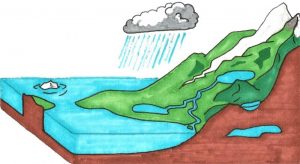
- The hadal zone includes a series of marine trenches. There are 33 trenches and 13 valleys worldwide, 46 individual habitats in total. The average depth of the trenches is 8,216 km. The total area of the hadal zone is less than 0.2% of the entire seabed but represents 45% of the total depth range.
Animals of the hadal zone
Many marine organisms are found deep in the hadal and the most common groups are polychaetas, bivalves, gastropods, amphipods and holothurians. Although there is no sunlight in the area, it is known that it is inhabited by a type of marine life known as hadopelagic or hadal fauna. At first, the only fish believed to inhabit this place were called ratfish, but now we know of several types of animals such as a type of starfish called ofiuro, jellyfish, sea cucumbers and some cartilaginous species such as the octopus Dumbo, which is capable of surviving even at depths greater than 5,000 meters deep. Within the fauna we can find slugs with sharp fins that can inhabit up to 9,000 meters deep. Some species that can be found are:
- The ghost fish is the only organism on Earth that uses mirrors in its eyes instead of lenses. Each eye has two parts, one pointing upward and one pointing downward, so he can see prey and predators.
- Black dragon fish are long, proportionately thin animals, but in real life they are only about 40 cm long in females and 5 cm in males. It has two red lights that allow him to see without being seen and to attract his prey, use a long and flexible accessory on his chin, whose end is illuminated. They are tertiary consumers of this part of the sea and eat other fish.
- The fisherman is spectacular due to the parasitic relationship between males and females. Most organisms would be in a parasitic relationship with a member of a different species, but the male fisherman actually feeds and damages the female. Fishermen are black, grey or brown color, with large heads and sharp, translucent teeth.
- The eel shark is one of the least known species, its body is elongated and flexible, with very bright eyes and thin, needle-like long teeth.
Plants of the hadal zone
There are no plants in the hadal area. This is because in these areas, sunlight cannot reach and for this reason, plants are not able to grow or reproduce.