Greek art characteristics
Greek art is a broad and interesting subject, its main features and characteristics are as follows:
- Use aesthetic idealism to give perfect vision.
- Its works have both proportionality and balance.
- They seek to represent the human figure in a perfect way, both in drawing and sculpture, so they focused largely on athletics to show perfect and muscular bodies.
- It’s based on anthropocentrism.
- They manifest nature as an idealized form full of simplicity and proportion, clarity and unity.
- Their knowledge of anatomy was broad.
- The gods Zeus and Athena stood out at all times.
- They focused on the use of Greek mythology to make their sculptures.
Backgrounds
Greek art was part of Hellenistic culture and was not a homogeneous type of culture because it had a wide variety of tribes that at the same time were united by common ancestors who shared the same language and religion. The historical antecedent that marks the starting point of Greek art was the Dorian Invasion in the 12th century B.C. It arose together with the Athenian democracy crisis and the Peloponnesian wars that were already shown in dramatic type of sculpture of the time that together with realism tried to manifest human feelings without leaving aside the religious part.
History
The historical origin of Greek art goes back to the movements carried out by people during the Bronze Age, a period between the I and II millennia before our times, approximately in the years 1100 and 100 BC. The invasions to the Balkan Peninsula by the Achaeans created different colonies in which the Greeks imposed their civilization giving as a result a civilization with similar characteristics.
Greek art stages
- Geometric Stage: Originating between the X and VIII century B.C. Its name comes from the type of ceramics that were made. The human figure appears very schematized and vases used in funerary rituals The main theme of this period was death and it occurred mainly in Athens. During this period pixies, pitchers, triglyphs and sculptures were created.
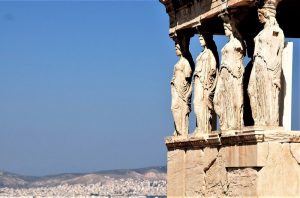 Archaic Stage: It is situated between the 8th and 6th century BC and is characterized by the expansion of the Greek polis using tyranny as propaganda. Within its commercial activity, important changes took place and the first cities and temples that changed sculpture and ceramics appeared. Importance was given to religious worship and important stone religious buildings and sanctuaries were built.
- Classical Stage: From the 5th to the 4th century B.C. when Greece reached plenitude in all fields, mainly in sculpture. It was influenced by the Egyptian and Babylonian culture from which a cultural mixture arose. The style of art at this stage was called Severe Style and bronze and marble were the most commonly used materials.
- Hellenistic stage: Between the 3rd century B.C. and the 1st century B.C. Greek culture spread throughout the Mediterranean. It is the most baroque stage of art and there was great demand for architectural works, sculpture and painting.
Greek art importance
Greek art is the basis of European and Western culture setting a precedent that remains today, its classical models and sculptures have been created throughout history. In addition, it was the basis of neoclassicism, which we see represented in different public and solemn buildings.
Architecture
The main element was the limestone or marble columns. They built theatres, stadiums and racetracks, but the most important component was the temple that guarded the divinity statue. Its temples were rectangular and had rooms with the image of a God. The columns had to have three parts: the architrave, the frieze and the cornice and enjoyed great proportion and harmony.
Sculpture
It was their main artistic manifestation and they focused on human body that represented different heroes, divinities and people. They gave great importance to proportion, balance and beauty using marble and bronze. They went from representing static figures to creating figures with movement and realism.
Paint
Religious, civil and funerary subjects were considered an art. They painted on boards and ceramics maintaining the pattern of lines and drawings full of colors. They used tempera painting and encaustic with fresco painting. The most used colors were red, yellow, black and white. Legends and historical battles, portraits, caricatures and landscapes were presented.
Representatives of Greek art
- Polyclitus
- Phidias
- Myron
- Calamus
- Agorácrito
Outstanding works
- Parthenon
- Erecteion
- Epidaurus
- Apollo
- Discobolo
- Diad Number
- Athena of Varvakeion