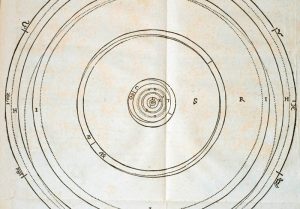
About geocentric theory
The Geocentric model or theory that was created by Greek astronomers indicated that all celestial bodies moving around the Earth followed paths that were completely circular. This thought was not something that had come out of nowhere, but Greek mathematicians and philosophers regarded the circle as a perfect geometric figure suitable for celestial motion.
In other words, geocentric theory is a theory that refers to the location of the Earth in the Universe. It is in charge of placing the Earth as the center of the Universe and places the stars rotating around it.
Who proposed it?
In the 4th century B.C., two of the most influential and important Greek philosophers, Aristotle and Plato, wrote a series of works based on the Geocentric model in which the Earth was a static sphere at the center of the universe. It was Claudio Ptolemy, who was in charge of proposing a model of the Universe with the Earth in the center. In the model, the Earth was stationary while the planets, the moon and the sun made complicated orbits around it.
Background
This theory has its antecedents mainly in ancient Greece, as Aristotle and Ptolemy believed in it. Most Greeks believed that the Sun, Moon, stars and planets were orbiting the Earth. Ideas very similar to this one were also carried in ancient China. In addition, in classical antiquity, scientists in the way in which the movement of the planets had occurred and how they fitted into the celestial orbs.
History
Geocentric theory was developed in Ancient Greece by a group of important philosophers and received its name when Claudius Ptolemy embodied his interpretations in ancient papyri for his work which he called The Almagest. In Ptolemy’s Almagesto, Ptolemy explains how planets, the Sun and stars orbit the Earth, thus introducing the concepts of the geometric models that epicycles had.
Characteristics of geocentric theory
The main characteristics of geocentric theory are as follows:
- This is one of the oldest man-made theories.
- The planet earth is located in the center of the universe.
- It was developed in ancient Greece.
- It was born in part to the influence of the religion that was at that time.
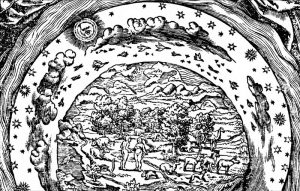
- It defended that the earth was immobile in space.
Postulates
Copernicus’ postulates about his geocentric theory were as follows:
- There is no center of gravity of all circles or celestial spheres.
- The center of the earth is not the center of the universe, but only gravity and the lunar sphere.
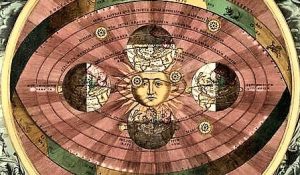
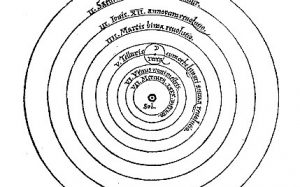
- All spheres revolve around the sun as their midpoint, and therefore, the sun is the center of the universe.
- The reason for the distance from the earth to the sun and the height of the firmament is at such a lower point than the reason between the radius of the earth and the distance from the sun, that the distance from the earth to the sun is imperceptible, if compared with the height of the firmament.
- Every apparent movement in the heavens comes from the movement of the earth, and not from some movement of the firmament, whatever it may be.
- What we believe is the movement of the sun does not come from the movement of it, but from the movement of the earth and of our sphere, together with which we revolve around the sun, just like any other planet.
- The seemingly direct and retrograde movement of the planets does not come from their movement, but from that of the earth. Therefore, the movement of the earth alone to explain the apparent anomalies of the heavens.
What problems it presents
One of the main problems that this model had was because the revolutions of spheres could not explain all the astronomical phenomena that occurred in the sky. In particular, it was observed that planets wandered the fixed fields of stars over time; most wandered in one direction, but occasionally seemed to reverse course.
Importance of geocentric theory
The main importance we can get from geocentric theory was that this theory served as a basis for Galileo and Kepler to lay the foundations of modern astronomy some time later.