Characteristics of electromotive force
In order for the relation of electromotive force takes place, it is necessary the existence of a difference of potential between two poles, where one is negative and one is positive, with the purpose of being able to propitiate the electrical charges by means of an open or closed circuit.
Electromotive force circuits can be both open and closed, an open circuit is characterized because it generates an electric current, which, being interrupted or not, is not communicated by an electric conductor, does not run. This causes that it cannot produce the proper flow of energy, producing that energy is not used by the electric current and the connection is not effective when it is open.
On the other hand, the close or parallel electric circuit works correctly due to the fact that the electric current advances from the source generating energy, for example, a battery, a conductive wire towards the receivers, for example, the bulb, passes through the switch and turns the generator where it is connected, providing the effectiveness of the electric circuit.
How electromotive force is measured
The electromotive force is measured or calculated from a voltage, which is called potential or tension. The force with electrical charges makes its way from negative charging unit to positive pole. This is divided by its value in coulombs (this being represented in Joules/Coulomb). It is summarized by talking about volts (V), which is equivalent to joules between coulomb (J/C).
Formula
The electromotive force in a closed circuit is equivalent to the induction flux variation of the magnetic field. This is expressed by the following formula, alluding to Faraday’s law:

This formula can also have the minus sign “-“.
Sources
The electromotive force can be produced by different sources:
- Direct electromotive force source: Obtains the electrical charge flow from direct devices, such as batteries, rechargeable batteries, non-rechargeable and solar batteries, accumulators. This causes the generated current having a constant value and an interval of relatively large duration and proportional to the size and strength of the generating device.
- Source of alternating electromotive force: In this case, the electrical current obtained is variable over time, as in the case of automobile generators, which are responsible for providing electricity for its proper functioning.
- Source of variable electromotive force not alternating: There is a source of energy that is variable, as in the case of piezoelectric lighters in a kitchen, as they produce an electrical discharge in the air, which is variable to the intensity and subject to the environment, thus acquiring the factor of little durability.
How electromotive force is generated
It can be generated through static, where attraction and repulsion forces on other electrical charges are generated by rubbing, for example, when a plastic comb is rubbed, and a static electrical charge is generated. Likewise, the electromotive force can be produced through induction, where the electric charges acquire movement when they are in a viable magnetic field.
Examples
- Batteries: Are catalogued as sources of electromotive energy because they are capable of generating energy by chemical means. Some of them, as in the case of carbon-zinc and alkaline batteries, when consumed at their maximum capacity, cannot be rechargeable. On the other hand, batteries composed of nickel-cadmium (NiCad), nickel and metal hydride (Ni-MH) and lithium ion, are capable of being rechargeable.
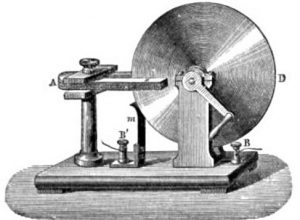
- Electromagnetic machines: These are machines that generate electrical energy based on magnetic and mechanical means, as in the case of small dynamos and generators, such as, for example, those frequently used in motor vehicles, portable electrical plants, among others. They are capable of supplying electrical energy to large structures, such as industries and cities.