It is a relatively small portion of the brain, about ten percent of total weight, but it contains about half of the brain’s neurons, the specialized cells that transmit information through electrical signals. The cerebellum is not exclusive to humans because it is also present in animals. Evolutionarily speaking, it is the oldest portion of the brain.
Histology
The histological pattern of the cortex is basically the same in all areas and can be considered to be the sum of a multitude of histo-functional units known as lamellas. The cerebellum cortex is a structure approximately 1 mm thick and consists of three main layers: the molecular layer, the granular layer and an intermediate layer in which the Purkinje cells are located.
These Purkinje cells are unique and possess a large number of dendrites, their axons form a pathway for the correct output of information that leaves the cerebellar cortex and distributes the information to the neurons in the gray nuclei of the cerebellum.
We find within the cerebellum two different types of sensitive afferences, the climbing fibers and the mosses which, in turn, influence the Purkinje cells.
When a cut is made in the cerebellum, two types of nerve tissue can be seen, the grey substance and the white. The grey substance creates a thin film that covers the cerebellar surface. The junction between the cerebellum and the brainstem is made through the cerebellar peduncles, which are the entry and exit routes for information.
You can also find cerebellar afferences that are formed in turn by cerebellar thorn fascicles, one dorsal and one ventral. We find a molecular layer, a granulosa, the axons of Purkinje, moss and climbing fibers and the white substance.
Cerebellum characteristics
The most notable characteristics of the cerebellum are the following:
- It has ovoid form and weighs approximately between 150 and 180 gr.
- The cerebellum of a man is heavier than that of a woman.
- Its approximate size is 8 cm x 5 cm x 5 cm.
- It is covered by spinal brain fluid.
- It is formed by two hemispheres with a cavity in the center called Vermis.
- In the cerebellum we find about 50% of the neurons in the brain.
Location
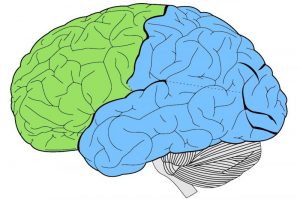
It is located in the posterior part of the brain at the level of the brain stem bridge, below the occipital lobe, a little above the nape of the neck. The peduncles are in charge of joining the cerebellum with the brain.
Parts of the cerebellum
The cerebellum has a surface with transverse grooves. According to these grooves, it has the following parts:
- Anterior lobe: It is located above the Fissure Prima. It connects the cerebellum with the spinal cord. It regulates muscle tone, movement of the trunk and extremities.
- Posterior lobe: Located between the Fissure Prima and the Left Posterior Cruise, its function is to connect the cortex. It regulates voluntary movements and cognitive functions.
- Flocculonodular lobe: It is below the Posterolateral Fissure and connects the vestibular and reticular It promotes balance, position, head displacement and eye movements.
Nuclei
The nuclei that exist in the cerebellum are a group of neuronal bodies that function in a coordinated way to carry out a series of functions. The most important nuclei of the cerebellum are:
- Fastigial Nucleus: it is also known as the nucleus of the roof and is in charge of receiving the projections from the cortex of the vermis.
- Globose nucleus: called posterior interposition and is the cortex that is located between the vermis and the two cerebellar hemispheres.
- Emboliform nucleus: receives the projections that occur from the cerebral cortex.
- Toothed nucleus: it is divided in a lateral part, a toothed paleo and another not toothed
Function
The primary function of the cerebellum is to coordinate the sensory and motor pathways. This means that it is the cerebellum that makes it possible for the muscles to react to different sensory stimuli. It generates reactions or responses quickly when a danger signal is generated from the outside and then sends the signal to the brain so that the brain can react quickly, and the reaction occurs.
It also participates in the proper conservation of muscle tone, intervenes and regulates the movements of the human body, both voluntary and involuntary, as well as the muscles surrounding the skeleton.
Diseases and injuries of the cerebellum
The most common lesions in the cerebellum are the following:
- Cancer
- Genetic diseases, such as Dandy Walker’s
- Cell degeneration that occurs when brain cells are defective.
- Lower-than-normal hypotonia or muscle tone.
- Movement disorder or ataxias, which is manifested by lack of muscle control in legs and arms.
- Cognitive-affective cerebellar syndrome that affects emotions and thought, attention, memory, language and personality may be affected.