Features of Turing Machine
The main features of the Turing machine were as follows:
- The input that the tape has before the calculation begins, must consist of a finite number of symbols.
- The machine tape has an unlimited length.
- The read/write head can be programmable.
- The Turing machine is capable of doing six types of fundamental operations: read, write, move left, move right, change state and stop.
- It has the ability to compute anything any modern computer can calculate.
- It consists of an input and output alphabet and a special symbol called white.
History of Turing machine
Alan Mathison Turing was the inventor of the Turing machine. He was known as an extremely talented man, who had great influences on the development of computing and on the formalization of the concept of algorithm and computation through his Turing machine, which played a very important role in the creation of the modern computer.
Turing described it for the first time in his 1936 article dealing with issues concerning computable numbers. In his article, Turing imagines that his creation is not a mechanical machine, but rather a person he decided to call a computer, which carelessly executes these deterministic mechanical rules.
How it works
The Turing machine operates through a finite control, a reader head and a ribbon on which there may be different characters, and on which the input word is found. To the right side, the ribbon has a length which is the place where the spaces are filled with the white character which is represented by the letter “t”. To its left side, the opposite happens because the tape is not infinite, reason why there is a picture of the tape that is the left side. In addition, it has a head that moves to the left and right, so it has the ability to pass in repeated cycles over the same segment of the tape.
The machine consists of an input and output alphabet, a special symbol known as white which is normally represented by a b, Δ or 0, a group of finite states, and a set of transitions between these states.
Its operation is based on the transition, which is responsible for receiving an initial state and a string of characters which belong to the input alphabet. From that moment on, the machine begins to read a band cell, deleting the symbol, and writing the new symbol that belongs to the output alphabet and then advances to the left or right, one time at a time and repeating the process as indicated in the transition function. At the end of the process it stops in an acceptance state, thus representing the output.
Uses of the Turing machine
The Turing machine has been, for example, used as a language generator, because this type of machine has several tapes including an output tape that is empty at first and then filled with words of language. It is also used in compilers I and II, state machines, automaton machines and code generators.
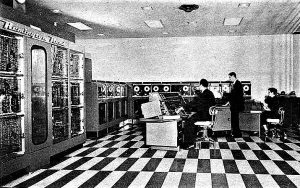
In the antiquity it was used in machines as the “Bombe” that was a device used by the British cryptologists to decipher signals encrypted by the German machine “enigma” during the Second World War. Also in the “colossus” machines that deciphered the encrypted messages intercepted in the communications of the Nazis.
Examples
Some examples of the Turing machine are:
- An X chain followed by a Y chain. Both of the same length.
- X^n Y^n, n>0}
- Tape initial state: 000111#
- Transitions:
- 0 0 X r 1
- 1 0 0 r 1
- 1 Y Y r 1
- 2 X X r 0
- 3 Y Y r 3
- 0 Y Y r 3
- 1 1 Y l 2
- 2 0 0 l 2
- 2 Y Y l 2
- 3 # # r 4
- 4 * * r halt