History
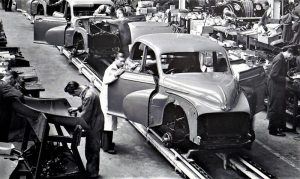
Throughout history, supply chain management has evolved from an initial focus on improving relatively simple but labor-intensive processes, to today’s engineering and management of complex global networks.
The supply chain has its origins in industrial engineering and in research which has its roots in logistics. Fredrick Taylor is considered the father of industrial engineering and focused his initial research on how to improve manual loading processes.
In the 1940s and 1950s, the logistic research approach was used to improve material handling processes and how to take advantage of space. The concept of “unit load” gained popularity and the use of pallets became widespread. In the mid-1950s, this concept was extended to transport management with the development of intermodal containers along with ships, trains and trucks to handle these containers. This was a prerequisite for the much later globalization of the supply chain.
The Production and Distribution Research Center was the first leader in innovation by combining map interfaces with optimization models for supply chain design and distribution planning.
Supply chain characteristics
The main characteristics of supply chains are as follows:
- The main part of the supply chain is the customer.
- Its purpose is to satisfy all customer needs.
- It includes customers, wholesalers, retailers, manufacturers and material suppliers that are necessary for the elaboration of the product.
- Supply chains are connected by the flow of products and information.
- It involves the continuous flow of information, so it is considered dynamic.
- Its design will depend on the needs of the client.
Aims and objectives
The objectives of a supply chain are:
- Seek profitability so that, operations can have a cost according to the budget and to generate savings.
- Specialization, which means that they need expert and strategic people depending on the subject matter.
- Be sensitive to changes in the market and adapt to them to meet the consumer needs for products or services.
- To have visibility over their processes, from the moment the client orders a product until it is manufactured and shipped.
- To be integral to unite the whole in a single concept of efficiency. It avoids biasing or treating the parts in an isolated way, on the contrary, it seeks to integrate them and give security in all its processes.
- To give the possibility to suppliers to make decisions and they can fulfill the performance and the budgeted results.
Supply chain functions
Supply chains have different functions among which we can mention the following:
- Manage the portfolios of products and services offered by the company in the market.
- To give a service to the client in a responsible way looking for connecting the necessity of the client with the internal operation of the company.
- Control production using the company’s particular service policies.
- Schedule internal production and accelerate input supply activity.
- Provide the different inputs that are needed to meet the needs of Production.
- To take care of the inputs and the finished product so that it reaches the clients or the companies that distribute it.
Process
There are three different processes within supply chains, these are:
- Supply: it is the way in which, when and where the different raw materials are obtained, in order to be able to move on to the transformation phase.
- Manufacturing: the process of converting raw materials into finished products. In this respect, the lower the production costs, the cheaper the final product can be.
- Distribution: is the process that is responsible for moving the final product to shops, factories and points of sale so that it can be purchased by the consumer.
Elements
The different elements of the supply chain are:
- Production: a key element of the chain that focuses on products,
- Supply and inventory.
- Location and transportation.
- Information.
- Reverse logistics.
Structure
It is based on two different dimensions that are used to describe, understand, analyze and be able to manage the supply chain, the horizontal and the vertical. Horizontal structure is the number of steps in a product chain that are: distributor, sales team and consumer. The vertical structure is the number of suppliers and customers in each tier.
Supply chain types
There are two types of supply chains, these are as follows:
- The strategic supply chain consists of making decisions regarding production technology, plant size, product selection, product placement within the plant and selection of the best supplier for raw materials.
- Tactical supply chain: infers that the chain is given and therefore has the function of deciding how resources will be used specifically, this includes suppliers, warehouses and sales centers, across a planning horizon.
Importance
Supply chains are important because they encompass all activities that are related to the movement of goods from the supply of raw materials to the product reaching the hands of the consumer. This includes greater control over selection, purchasing, production scheduling, order processing, inventory control, transportation, warehousing, and customer service. In addition, it includes the information systems needed to monitor all these activities.
Examples
Some companies that work based on supply chains are:
- Walmart
- Zara
- Coca Cola