Characteristics of rail transport
Among the main characteristics of rail transport, we can mention the following:
- It has great load capacity.
- It works at an international
- It is reliable and a very safe means of transport.
- It is special for transporting loads over long distances.
- It is a flexible
- It is ecological so it helps to reduce environmental pollution.
- It is a slow transport but quite economic.
History of rail transport
In the 18th century, workers in mining areas of Europe observed that loaded wagons moved more easily if the wheels were guided by a rail made of metal plates, as this reduced friction, and so began the story. The beginning of the Industrial Revolution demanded more efficient ways of bringing raw materials to new factories and moving finished products from them. English mining engineer Richard Trevithick was the first to use the train and adapt the steam engine, which was used in the early 18th century to pump water, to pull a locomotive in South Wales. Twenty years later, the rails were developed from cast iron to support the weight of the steam locomotive. The first public railroad for passengers and cargo was the Liverpool-Manchester, inaugurated in 1830. It was also run by George Stephenson, with the help of his son Robert Stephenson.
Evolution of rail transport
The first means of transport that used wheels mounted on rails was designed by the Englishman Richard Trevithick on February 24, 1804. This can be considered as the first train. The first public transport to operate with steam locomotives was inaugurated in 1830. It followed the track from Liverpool to Manchester, England. This first rail transport company was run by George Stephenson with the help of his son Robert. In the United States the railroad developed in search of a way to communicate cities from the east coast to the interior of the country. The first steam railway was opened in 1830 in Charleston. The construction of railroads spread throughout the world, because it was an effective, public and low-cost means of transport and allowed to transport different types of cargo and people to areas in the interior of the continents.
Types
- Metro: an underground railway for urban use.
- Light rail: used for passenger transport in urban areas.
- Tram: an urban railway.
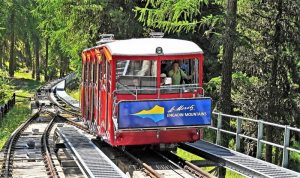
- Funicular: it is pulled by cable, normally from point to point, in places of great slopes.
- Rack and pinion trains: this is the train in which adherence is improved by means of a rack and pinion system, where there are steep slopes.
- Atmospheric: it uses compressed air inside a tube as a motor, which makes it drag the train.
- Pneumatic: the train is pushed by the action of compressed air marching as a piston inside a tube.
Advantages
The advantages of using rail transport are as follows:
- Trains have a high capacity to transport loads of all sizes regardless if they are large quantities of goods and if the journeys are short or long.
- The costs of operating trains are generally quite low, which helps companies’ economies.
- It is a means of transport that offers great flexibility so that, different types of goods can be transported.
- Trains have a low risk of accidents.
- Trains are environmentally friendly because they are very low pollutants, avoiding environmental pollution.
- Compared to road transport, it avoids the problems of traffic congestion.
- Possibility of intermodality with other methods of transport.
Disadvantages
Some of its disadvantages are:
- The railroad is not exclusive for trade.
- Its speed is considerably low.
- It has certain restrictions of height and volumes of passage through the different bridges.
- It depends on the infrastructure of the country.
- Merchandise can only be transported as far as the tracks go, in other words, it cannot reach specific warehouses or production centers.
- Extra vehicles are needed to transport the cargo to the storage site or place of operation.
Importance of rail transport
The railways are one of the most important means of land transport as it is one of the most productive ways of carrying out goods exchanges and to concentrate the different shipments from one place to another.
Uses
Its main uses are the transport of materials and the transport of people to different places, either within the same territory or outside it.
Some examples
- Mexico: they have the Mexico Valley Suburban Train line and the Mexico-Toluca Interurban Train (currently under construction) that are part of the Ferrovalle They have tourist trains, both near and far.
- Spain: it has Iberian, international and metric gauge lines. The railway network is formed by the lines of the General Interest Railway Network and by the lines whose ownership has been transferred to the autonomous communities.