Etymology
The word megalopolis comes from the Greek language Μεuάλη which means megáli or big, and, πόλις which means polis or city. The person in charge of introducing this new word worldwide was the French geographer Jean Gottmann in 1961, and he did it through his book called “Megalopolis, The Urbanized Northeastern Seaboard of the United States”, which translated into Spanish means: Megalópolis, el urbanizado borde marítimo al noreste de Estados Unidos. In his book, he referred to the urban system that achieved having a population equal to or greater than 10 million inhabitants.
Characteristics
- To be considered a megalopolis, the city must have at least 10 million
- The growth of these Cities is very fast
- They have a concentrated money market, which ranges from the country’s capital to major financial institutions, stock exchanges and insurance companies.
- It forms a revolution in land distribution by creating a new pattern of symbiosis between rural and urban, partly as a result of a new counterattack by manufacturers in suburban areas.
- In terms of jobs and trade, it establishes a cycle of high population density, meaning that there are many consumers and workers.
Megalopolis creation
The creation of megalopolis or mega-cities occurs through a series of poli nuclearization phenomena. Several interurban assemblages are formed thanks to infrastructure, health and environmental works, as well as the quality of distribution and services. In the course of their training, a number of different connectivity and traffic problems arise, leading to major and important public works linked to transport and the structures of the internal and surrounding spaces within the megalopolis. They are also formed through the effective articulation of the urban and interurban elements that compose them. It is for this reason that major coordination and joint management efforts are required in order to create a megalopolis.
Administration system
Each megalopolis has its own administration system, depending on the country. Each country has its own way of managing its assets, imposing laws, distributing and creating products and services. They do work together to carry out major works that are directly linked to transport and communication.
Environment
Model-based analysis shows that future urban expansion will result in significant regional climate change. Future urban expansion will result in an average annual temperature increase ranging from 2°C to 5°C in a new urban area, and an average annual temperature decrease ranging from 0.40°C to 1.20°C in the south of megacities. The future warming effect of urban expansion in the original and new urban area, and the effects of drought in the non-urban area will be more severe in summer than in winter, affecting the flora and fauna of a place. A cooling effect will appear in the original urban area in winter. Some research shows that megacities have an integrated effect of combination and interaction of multiple cities and their surrounding areas, which can crucially determine the regional climate pattern and should be highly valued in the future.
Examples of megalopolis
Today, the megalopolises of Africa are typical examples of the third world, consisting of rapid demographic growth in certain points due to the high birth rate, the exodus from the countryside to the city and concentrations of the few economic resources of the countries.
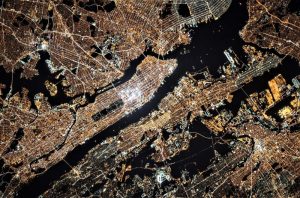
BosWash, located in the United States, is made up of places such as Boston, Providence, Hartford, New York, Philadelphia, Baltimore, Washington, D.C. and other smaller metropolitan areas. This important megalopolis is also known as the northeast corridor, the most populous and extensive area in the Western Hemisphere.
In Mexico, the Regional Crown of the Center of the Country around the Valley of Mexico along with the metropolitan areas of Puebla – Tlaxcala, Cuernavaca – Cuautla, Toluca, Pachuca, Tula de Allende – Tulancingo – Querétaro – San Juan del Río and the Bajío Corridor or Aguascalientes, León, Silao, Guanajuato, Irapuato, Salamanca, Cortazar, Celaya, Querétaro, San Juan del Rio and the Metropolitan Area of Southern Guanajuato. Together, these cities have more than 35 million inhabitants.