Location of the Indian Ocean
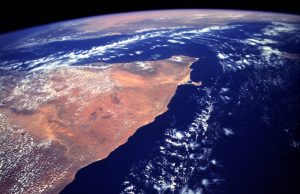
It lies between East Africa, Southern India and Oceania and Northern Antarctica. The Indian Ocean is bounded by Iran, Pakistan, India and Bangladesh to the north; the Malay Peninsula, the Sunda Islands of Indonesia and Australia to the east; Antarctica to the south; and Africa and the Arabian Peninsula to the west. In the southwest it joins the Atlantic Ocean to the south of the southern tip of Africa, and to the east and southeast its waters mix with those of the Pacific Ocean.
History of the Indian Ocean
It is believed that the first civilizations developed around its waters. During the first dynasty of Egypt, different expeditions left to navigate its waters finding gold and myrrh. The first trade between Mesopotamia and the Indus Valley took place in the Indian Ocean. The Indonesian peoples crossed it to settle in Madagascar. The first Greek to cross the ocean to India was Hippalus. Trade relations between Egypt and South India developed there. The first European navigator who sailed its waters was Vasco de Gama, dominating the trade.
Characteristics
The most outstanding characteristics of the Indian Ocean are as follows:
- The salinity of its waters is approximately 3.2 and 3.7%.
- Its surface temperature in the south is about 22° Celsius, while in the east it can exceed 28° Celsius.
- The circulation of its waters is controlled by flows from the Atlantic Ocean, the Red Sea and Antarctic currents.
- It is a very young ocean, for this reason there are cliffs and mountain ranges.
- Its average depth is approximately 4,210 meters.
- Its lowest point is off the south coast of the Indonesian island of Java.
- The currents of its rivers are controlled mainly by the monsoons.
- Its most important economic function is product transport.
- It is made up of the Andaman Sea, the Arabian Sea, the Red Sea, the Sea of Savu and the Gulf of Carpentaria.
Indian Ocean islands
The islands we can find in the Indian Ocean are the following:
- Indonesian Archipelago
- Maldives
- Mauritius
- Sri Lanka
- Maldives
- Madagascar
- Seychelles
Weather
In its southern part the climate is very stable and in its northern part, monsoons can be found. Monsoon winds thus affect the climate in the northern part of the equator. In the southern hemisphere, the winds are less intense, but there are storms that occur in the summer that are quite strong.
When drastic changes occur in the monsoons, cyclones hit the coasts.
Fauna
The marine fauna of the ocean is very limited because in ocean does not possess the necessary quantities of phytoplankton to give nutrients to the fish. In its northern part, you can find more marine species that are a source of exploitation mainly for domestic consumption. Shrimp and tuna are two species that can be found in the area. Among the marine animals that inhabit the area and are already in danger of extinction are turtles and whales.
Flora
Due to its climate, there is little vegetation, but the most common are teak and cane, which are typical flowers of the area. On its islands we can find citrus lemon, which is a flowering tree that produces lemon. The tiliaceus hibiscus is an ornamental tree with flowers native of the coasts of the Indian Ocean. Teak is used for the construction of doors, windows and furniture. The common cane is a perennial herb, with high leaves which they use to make baskets and reeds for instruments.
Importance
In the Indian Ocean we can find many oil and natural gas deposits. It is an important source of fishing, sand and gravel, which are used by different sectors of industry. It has four important routes for navigation which allows to transport goods from one place to another, mainly the routes between the Middle East, Africa and Asia with Europe.
Why it is called the Indian Ocean
The Indian Ocean was named by Portuguese explorer Fernando de Magallanes during one of his expeditions. Its name was given because it is found bathing the coasts of Indonesia and India.