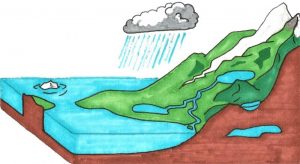
About the hydrological cycle
The hydrological cycle consists of the process by which water is mobilized inside and outside the Earth. It happens because water is in motion, changing state and for this reason we find water in liquid, solid or gaseous state. The water cycle does not have a starting point, but the oceans are always taken as this one, since it is there where the greatest amount of water on Earth is found.
It begins when a portion of the water in the oceans evaporates through sunlight. This light heats the water and causes it to change state, evaporating and passing into the atmosphere along with the air. A part of this vapor comes directly from the solid state when pieces of ice and snow are subjected to a state of sublimation.
When air currents rise, water vapor goes into the atmosphere including water vapor from oceans, ice, snow, and some other sources. The steam then rises to the highest part of the atmosphere, where the air is cooler. With this phenomenon, water condenses in the form of clouds. The different water currents cause particles from the clouds to collide, grow and fall to the ground in the form of precipitation.
What is it for?
The hydrological cycle is essential to maintain the balance of the earth’s ecosystems, and to be able to provide fresh and pure water to all living beings, thanks to the recirculation of this vital liquid. All forms of water are considered to participate in the water cycle, which is indispensable for the development of life on planet Earth. Basically, life without water would be impossible.
Components
The components of water are as follows:
- Precipitation: is all the water that falls to the surface of the earth either in liquid form such as rain and drizzles and solids such as snow or hail. Also included are hidden precipitations including dew and white frost.
- Evaporation: the process by which liquid water is converted to gas. It can happen only when water is available for the process.
- Condensation: the change in the state of matter from vapor to liquid that occurs when there is cooling. The process releases heat energy to the environment.
- Transpiration: is the evaporation that occurs through the leaves.
- Interception: is part of the precipitation that is intercepted by surface objects such as plant covers or roofs.
Stages
The stages of the hydrological cycle are as follows:
- Evaporation: physical process consisting of the gradual passage from a liquid state to a gaseous state, as a function of temperature. With the intensification of the displacement, the particles reach the atmosphere and are transformed into vapor.
- Condensation: the change in the state of water vapor in the air masses of the atmosphere to a liquid phase by cooling them down.
- Precipitation: it occurs when the relative humidity of water vapor in the atmosphere is 100%. If the temperature is very low the precipitation is like snow.
- Runoff: is the transit of water that circulates through a drainage basin infiltrated in the ground and causing the recharge of underground
- Transport: the movement of liquid water masses across the land surface forming rivers, lakes, seas and oceans.
How climate influences the hydrological cycle?
Climate models show that water will heat up depending on greenhouse gas levels. These changes will affect the quality and quantity of water available to humans and the environment. It is possible that when this happens, water quality will be affected, droughts will increase, and the intensity and frequency of rainfall will change drastically.
What role does the sun play in the hydrological cycle?
The function of the natural water cycle is to be an essential resource for life with strategic economic value. The natural cycle provides regions with many initial potentialities and limitations, and its availability is a prerequisite for the development of social and economic activities.
Effects
Some of the effects that can be observed by the hydrological cycle are:
- It raises seawater levels.
- There is the reduction or loss of some perennial ice or snow.
- It produces more intense and more frequent heat waves.
- There are changes in rainfall producing storms.
- Positive feedback of water vapor in the atmosphere.
- Water can carry solids and diluted gases, such as carbon, nitrogen, and sulfur, through the hydrologic cycle.
Importance
The hydrological cycle is a vital process for sustaining life on earth. It is through it that water is provided to all the planet’s ecosystems and to the living beings that need it in order to survive. It allows the growth of plants, the purification of terrestrial and aquatic waters, and, through evaporation, the pollutants are eliminated in order to turn the water into drinking water.
If we did not have the water cycle, substances that are harmful to health would progressively accumulate and water could no longer be consumed by humans or animals.