It is also the most common place for a brain injury to occur. Damage to the frontal lobe can create personality changes, limited facial expressions, and difficulty interpreting the environment, such as the inability to adequately assess risk and danger.
Frontal lobe characteristics
The main features of the frontal lobe are as follows:
- The frontal lobe is the characteristic of the human body that differentiates us from other animals.
- They allow us to have a great variety of functions and capacities.
- It is the lobe with the largest surface area in the brain.
- It is considered the most important lobe of the human body.
- It is located in the anterior part of the brain.
Frontal lobe location
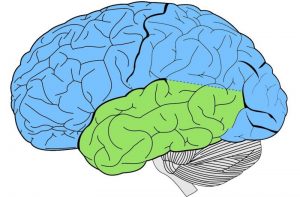
The frontal lobe is located in the frontal part of the brain, the part closest to the face. It is separated from the parietal lobe by means of the Rolando fissure or central fissure and separated from the temporal lobe through the Silvio fissure or lateral fissure.
It occupies approximately one third of the cerebral cortex and is the largest.
Areas
The frontal lobe areas are:
- Motor cortex: is the part of the frontal lobe related to the processes of planning, execution and control of voluntary movements. In it, information is formed about the environment and about the information processed in the brain, which is then converted into action. It is divided into primary motor cortex, premotor cortex and supplementary motor area. In the primary cortex there are nerve impulses that activate specific muscles. The premotor cortex helps to learn from past experiences and plays a very important role in the movements associated with posture control and proximal movements. The supplementary motor area, participates in the realization of precise movements, such as those that require the use of fingers in a coordinated manner.
- Prefrontal cortex: this is where the capacity to repress impulses and to think of abstract ideas The imagination of possible future situations is given from our past and social norms. In it are cognitive faculties and functions.
- Drill Area: It is related to the realization of concrete movements to be able to speak. It formulates signals that will go to the tongue, larynx and mouth.
Functions
The frontal lobes are closely related to the executive functions of the human body, such as cognition, decision making, correct use of memory, planning, and the way we solve our problems.
It has the function of sharing the information we get from the environment in order to make decisions about what we do and helps us make a plan of action. Thanks to it, we can go from being passive to active human beings, responding to the specific objectives we have.
It gives us the ability to think abstractly about things that are in our imagination, helps us to properly manage working memory and problem solving in real time. It allows us to project experiences that have happened in the past so that, we can see them in the future.
It helps us to imagine different plans and strategies, thinking about the possible results and the consequences they may have. It then forms future scenes in the mind and helps us visualize our goals.
They allow us to elaborate mental and emotional states with others, which in turn directly influences the way we behave.
Injuries and diseases of the frontal lobe
Lesions or pathologies of the frontal lobe affect the motor, cognitive, emotional and behavioral processes of the human being. For this reason, the pathologies are varied, some of them are:
- Motor disorders: they affect the primary motor and the premotor cortex, affecting the speed, execution and coordination of body movements. One of them is apraxia, in which the patient loses all ability to coordinate movements.
- Aphasia: is a language problem in which the patient loses verbal fluency, speak very slowly and poorly organized. They have no initiative and it is very difficult for them to write.
- Dysexecutive syndrome: occurs when an injury occurs in the prefrontal area of the lobe, and has symptoms such as loss of cognitive ability, attention deficit and difficulty regulating emotions and behaviors.
When there is damage to the dorsolateral area, problems may arise in resolving conflicts, a decrease in learning capacity, temporary memory impairment and poor motor programming.