The Caspian Sea is bordered by five countries, Iran, Russia, Azerbaijan, Turkmenistan and Kazakhstan. Three main rivers, the Volga, Ural and Terek, and numerous smaller rivers flow into its waters.
Four-fifths of the world’s sturgeon catch, which produce eggs that are processed into caviar, comes from the Caspian Sea. In recent years, desiccation of spawning grounds, pollution, river damming and overfishing have threatened the sturgeon population.
Location of the Caspian Sea
The Caspian Sea is located in the eastern part of the Caucasus Mountains, in a deep depression that exists between the continents of Europe and Asia, approximately between 27 and 28 meters below sea level.
Iran, Azerbaijan, Turkmenistan, Russia and Kazakhstan are the five countries that surround the sea and on its shores are a number of different cities such as Baku, Aktau and Majachkalá.
History of the Caspian Sea
According to historians and geographers it is considered that the sea is approximately 30 million years old. It became a lake with no access to the sea some 5.5 million years ago. Discoveries in the Huto cave near the town of Behshahr in Iran point to the existence of a human population in the area 75,000 years ago.
In the 1960s and 1970s, its water level dropped considerably, as many of its waters were used for irrigation and other activities. In 1980, a dam was built at the mouth of the Kara-Bogaz-Gol to control water loss. An aqueduct was built to recover the flow of water to the Kara-Bogaz-Gol.
In classical antiquity it was called the Hircanian Ocean and is also known as the Khazar Sea. In Persian antiquity, as well as in modern Iran, it is known as the Mazandaran Sea. In ancient Russia it was also known by a different name and was called the Khvalyn Sea name which was later changed to the Khvalis Sea.
Characteristics
The main characteristics of the Caspian Sea are as follows:
- The narrow and elongated basin of the Caspian Sea stretches almost 1,200 kilometers from north to south, with an average width of only 320 kilometers.
- We can find three large rivers that flow into the Caspian: the Volga, the Ural and the Terek.
- The eastern coast is important because of the absence of permanent currents.
- There are up to fifty islands in the Caspian Sea, most of them small.
- Based on the formations of the seabed and the hydrological characteristics it possesses, the Caspian basin is divided into the northern, middle and southern Caspian.
- The flat, sedimentary plain of the northern Caspian, located in a continental climate zone, is the shallowest part of the sea, with an average depth of 4 to 6 meters.
- The middle and southern Caspian is in a moderately warm climate, and evaporation from the sea surface reaches up to 1000 mm per year.
- Its waters are slightly salty.
Economy
It is an important area in terms of energy resources and oil fields. The region contains between 17 and 44 billion barrels of oil and gas reserves of approximately 230 trillion cubic feet.
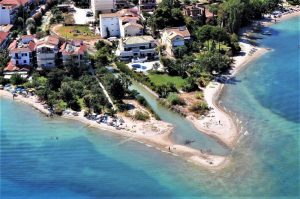
It is a popular destination for domestic tourists. In Iran, the Caspian coast offers sandy beaches, lush vegetation and spectacular natural scenery. There are several resorts, entertainment facilities and holiday homes. Winters with good weather and hot summers, as well as its accessibility also make the Caspian coast a favorite vacation spot for Russians.
Politics
Part of the struggle over the Caspian’s resources was not military but political, because different Western NGOs managed to get into two vital allies of Moscow and make a series of changes in pro-Russian regimes for new allies of the West in the post-Soviet space, through political advertisements and denunciations of fraud in parliamentary and presidential elections.
The policy is based on three major issues that seek to regulate the status of the Caspian Sea: access to mineral resources (oil and natural gas), access to fisheries and access to international waters (via the Volga River and the canals connecting to the Black Sea and the Baltic Sea).
In 2003, Russia, Kazakhstan and Azerbaijan reached an agreement on their sectors, covering 64 per cent of the Caspian Sea. There are no problems between Kazakhstan and Turkmenistan, but Turkmenistan is not actively involved in the agreement. Azerbaijan disagrees with Iran over the oil fields claimed by both states. There are similar tensions between Azerbaijan and Turkmenistan over the amount of oil pumped from a shared recognized field. The southern part of the sea remains contested.
Russia and Kazakhstan signed a treaty, according to which they divided the northern part of the Caspian Sea between them into two sectors along the middle line. Each sector is an exclusive zone of its state. Therefore, all resources, seabed and surface are unique to the particular state.
Why it is called the Caspian Sea
Its name comes from the word ” Caspian “. In Aramaic language of the word “Kspy” and the Greek of the word “Kaspioi“, name of the ancient people who lived in the southwest of the lake. The Greek geographer and historian Strabo made different notes on the Caspian territory in the Caucasian Albania that had taken this name in honor of the Caspian tribe. It is called sea because at the bottom of its waters is a layer of ocean type.
Which rivers flow into the Caspian Sea
The Caspian Sea has different tributaries, we can mainly mention the Volga River which in turn forms a wide delta, the Ural River and the Emba River that reach it from the north. Other tributaries, such as the Gorgan River and the Atrek River come from the east, and the Kura River from the west. The Caspian is connected to the Sea of Azov through the Manych Canal.
Let’s look at some of these rivers in more detail:
- Volga River: one of the largest and longest on Earth with a length of more than 3500 kilometers. It is born in Volgoverkhovye region of Tver and advances until arriving at the Russian Federation. The Volga river flows into the Caspian Sea, but has no direct access to the oceans, so it is an internal
- Ural: Born in Bashkortostan, it is the sixth largest river in the Russian Federation. The Ural belongs to Asia and is also a river of internal
- Emba: flows in the territory of Kazakhstan. Its basin measures 40,000 square meters.
- Terek: called mountain of water and runs through different states flowing into the Caspian Sea and the Gulf of Archangel. It measures a little more than 600 km.
- Sulac: has several hydroelectric power stations so it is considered one of the most important rivers.
- Atrek: born in the mountains between Turkmenistan and Kharasan. It is used for irrigation and reaches the Caspian Sea only during the flood period.
Fauna
The Caspian Sea has a large quantity of fish and the majority of the sturgeon is found there, from where the caviar is extracted. We find fish such as salmon, perch, herring and carp. In addition, you can find animals like the turtle and the seal. The Caspian seal, also called Caspian pose, is common in the Caspian, and is one of the few species of seal that live in inland waters.
In recent years there has been the problem of overfishing threatened to sturgeon so environmental groups have begun to fight for a ban on sturgeon fishing, despite this fight, the prices of sturgeon caviar are so high that fishermen bribe the authorities to avoid legislation.