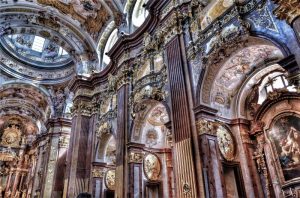
Characteristics of Byzantine art
For Byzantine art, church was conceived as a small cosmos full of divinity, it was a place in which everything that was there had a symbolism. They were a set of churches based on mystical beliefs and filled with spirituality. They were looking for a place that would be the axis of everything but at the same time, it was divided into spaces that could intercommunicate with each other and for this reason they used a series of curtains formed by lines of archery. They did not use elements individualization because they were looking for a way to create a continuous space.
It had a mysterious and to a certain extent mythical aspect because of the effect they caused with their light, and this was very important to them. The use of mosaics was another important characteristic, because there was the sensation of unification between its parts. Its architects, although they imitated in certain points Roman architects, elaborated all a scientific study for construction creating an architectural model doing a fusion of the basilica and central plant united by a dome of great size. The external parts were constructed with low quality and inexpensive materials such as bricks, since for them the interior was more important than the exterior, as did the Romans. The internal columns were elaborated with rich and luxurious materials.
Byzantine art history
Byzantine art was divided into three important stages:
- First Golden Age: This stage took place during the 6th and 7th centuries. This was an important period in which a language of its own and artistic origin was created. Its most significant moment was when Justinian was King during the years 527 and 565, a period during which the iconoclastic complaint arose.
- Second Golden Age: This stage defined the Byzantine iconography, it also produced the schism of the Eastern Church during the ninth and twelfth centuries, during which time a tremendous crisis arises because of the conquest against Constantinople founding the new Latin Empire.
- Third Golden Age: It happens when in 1258, the Paleologist Michael VIII, founded a completely new dynasty and began a new cultural and social renaissance, which lasted until Constantinople was invaded by the Turks.
Architecture in Byzantine art
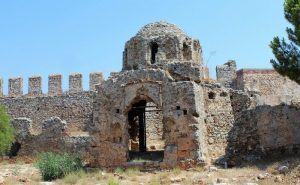 As for Byzantine art architecture, we can mention that the First Golden Age was the most important period of its architecture. It was an imperial architecture, with high prices because the emperor had a lot of money to finance all expenses. The churches were built with a central base and many vaults, surrounded by halls and pavilions in their gardens. Apparently, one of the aspects that most influenced its architecture was the liturgy, which did not need a special place if there was no separation between its halls. They used stones and mosaics for the structures creating an ambient that somehow manifested the presence of God in the place. Their works were perfect, and their architecture unrepeatable in the world. Later on, they used bricks combined with colored stones, the domes were built higher and had much more style.
Byzantine painting
Byzantine art used a lot of golden color to represent the sky. The painting reached its greatest splendor during the fourteenth century, prior to this date, was actually a little scarce. They venerated icons and religious paintings made on boards. All the icons they painted were placed in churches so that, they could be venerated by their believers and in this way they looked for how to represent Christ, the saints and the Virgin. The frescoes, paintings on church walls and panels were outstanding. Byzantine painting used the mosaic as its main theme and represented the figures in an elongated form, with their hands in a position to be carrying an object. They painted the faces giving it an expression of majesty and tranquility.