Origin of the asteroid belt
During the 18th century, astronomers created a pattern in several planets’ orbits that gave rise to the Titius-Bode law, which said how much space existed between the planets. In addition to this observation, they realized that there were large and small objects orbiting between Mars and Jupiter, and from here, was born the term asteroid, after they realized the large number of them, the term asteroid belt was born.
The current theory about the origin of the asteroid belt has been proposed by researchers at the University of Bordeaux. It suggests that, at an earlier point in history, the belt was overpopulated and that, through Jupiter’s gravitational pull, it threw approximately 99% of its material out of the solar system. They suggest that, then, the belt emerged from an empty space that then gradually filled with material that had been thrown from other planets. So, we can say that the asteroids reached the belt as it was created.
Where it is located
The belt is located between the orbits of Mars and Jupiter where we find thousands of asteroids occupying a strip located at distances between 2 and 4 AU from the sun, this means between 300 and 600 kilometers. It is important to mention that 1 AU is an astronomical unit that marks the average distance between the sun and the earth and is equal to 149,597,871 km.
Characteristics of the asteroid belt
Some of its main features are:
- The asteroids in the belt are approximately 6 million years old.
- It functions as a boundary between the inner planets and the outer gaseous planets.
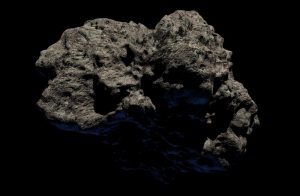
- The asteroids that make up the belt are made of carbon rocks and minerals such as iron and nickel.
- The total mass of the asteroid belt is estimated to be between 3.0×10²¹ and 3.6×10²¹ kg.
- The sizes of asteroids are very variable, and their size is known by measuring their distance.
- The brighter the asteroids, the larger their surface area will be because it reflects more sunlight.
Planets of the asteroid belt
The only planet we find in the asteroid belt has the name of Ceres and has been classified as a dwarf planet because its gravity has shaped it spherically. Towards 2006, it was considered to be the largest asteroid, but the theory changed from that year on. It has a magnitude of 3.32 more than any other body inside the belt and is formed by a silicate nucleus and a water layer as ice.
Featured asteroids
- Vesta: It is the second largest asteroid and is the brightest of them all. Its diameter is approximately 530 kilometers and it orbits at a distance from the sun very similar to Ceres’. Its nucleus is formed of iron and nickel, and it has an olivine mantle.
- Palas: It represents 7% of the belt and has the most eccentric orbit of the asteroids. Its distance is closer to the sun and its orbital inclination is higher.
- Higia: It is the fourth largest object within the belt with an average radius of approximately 431 kilometers. Its shape is elongated and constitutes 3% of the total mass of the belt. It is a carbon asteroid, is the most external and takes five and a half years to complete an orbit.
- Juno: It was the third asteroid to be discovered. It is the heaviest and was discovered on September 1, 1804, by the astronomer Karl Ledwig. It owes its name to the goddess Juno and at the beginning it was thought that it was a planet.
Curiosities
- It is constantly revolving around the sun.
- It has no gravity of its own and no atmosphere.
- All its asteroids are of different shapes and sizes.
- Although the planets were created from asteroids, the asteroids in the belt were never able to meet due to Jupiter’s strong gravity.
- Although there is a great distance between the asteroids, they always collide continuously.