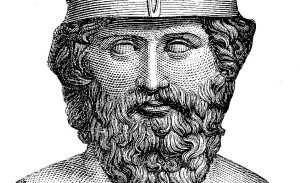
Biography of Aristophanes
Little is known about the life of Aristophanes, and most of the facts known derive from written references in his own works, many historians consider that he was born during the time of Pericles, and his birthday situates him around 445 BC. He was an Athenian citizen who belonged to the clan called Pandionis, but his actual place of birth is uncertain. He began his dramatic career in 427 B.C., with a play known as ” The Daitaleis ” whose meaning in Spanish is ” The Banquetros “, which seems, from surviving fragments, to have been a satire on the educational and moral theories of his contemporaries.
He was involved in Athenian politics and participated in different political struggles with the aim of establishing the Aristocratic Party. He was against the way in which the democrats ruled and was categorically opposed to the Peloponnese war.
What he did?
Aristophanes was a recognized comedian who was in charge of making a series of criticisms using satire against the sophists, mainly against Socrates. He did a lot of comedies in Classic Grace with the aim of criticizing the society of his time through different situations and characters.
Ideology of Aristophanes
Aristophanes’ political ideology was characterized by the conservatism of a person who goes against the defenders of people and institutions. He had an extremely conservative position that supposedly reflected his pacifism, which was in line with the position of the peasants of Athens during the Peloponnese War. It focused on criticizing democracy and revolution. He went against the religious and mocked the gods. Regarding his political ideology he was very conservative and always thought that education was important.
Physical characteristics
Just like his life, very little is known about his physical characteristics.
Personality
He was a man who was always against the war and who fought politically against the Democratic government. He had a very conservative stance that guided him in defending religious myths and did not accept new philosophical doctrines. He was also characterized by attacking institutions and societies through his political comedies, was a faithful follower of the model of ideal political society using censorship and sharp criticism against citizen politics. His personality was completely humorous and was reflected in his language and style, in which he managed to achieve an important comedy. He was able to distort and give two meanings to his ideas.
Importance
The main importance of Aristophanes is that thanks to his work, adequate importance is given to social and human criticism today. He was an example to each citizen as a citizenship master through his works. He was also seen as a positive influence on the life of the city of Athens because he managed to establish direct relations with its public.
Works by Aristophanes
Eleven comedies that reached the Alexandrian era are preserved. His works were full of great dynamism due to the use of music, dialogues and choirs. Among his most important works we mention:
- The Acamenses: referred to the Athens – Sparta war, and invited the Athenian politicians to end the war and to begin a period of peace.
- The Knights: a satirical work criticizing the soldier and strategist Cleon, leader of the warmongering party.
- The Clouds: a satire against the sophists, mainly against Socrates, because Aristophanes believed that his oratory was used for political purposes.
- The wasps: satire related to the Athenian justice and on the strategist Cleon where this work is criticized as the Athenian citizens who are obsessed with being popular juries in the courts of Athens.
- Peace: it includes a main character who represents a country man who, disgusted by the war, decides to go and visit the Gods so that they intercede with the Greeks to restore peace.
- Birds: a work in which he criticizes Athenian society and its strange taste for mixing in problems of a judicial nature.
- Lysistrata: this is undoubtedly his best known work, in which the women establish a pact by means of which they will not be able to have sexual relations with their husbands until the war is over, as a way of pressuring to initiate peace.
- The Tesmoforiazusas and The Frogs: these works were a direct attack on Euripides.
Poems
Among his main poems we can mention:
- Lysistrata
- The Beast of Aristophanes
- The clouds
Myth
Among their myths we mention the following:
- Androgynous
- Faceless
- The theory of the better half.
- The theory of soul mates.
Aristophanes phrases
Some of his most recognized phrases are:
- Distrust is the mother of security.
- Wise men learn much from their enemies.
- Virtue comes to light in adversity.
- Everyone knows that old men are twice children.
- You must be a rower before you take the helm, you must have been at the bow and observed the winds before you steer the ship.
- May the gods let each one perform the trade he knows!
- Blind humans, like a light leaf, impotent creatures made of miserable clay, miserable mortals who, deprived of wings, spend their fleeting lives as vain shadows or lying reveries.