History of the Andromeda Galaxy
According to some historical data, the first reference we have to the Andromeda Galaxy dates back to the year 964 and was made by the Persian astronomer known as Azophi, when in his libus of Fixed Stars, he gave a detailed description of a small cloud that was located in the Andromeda Constellation. The first telescopic observation of the galaxy was made in 1612 by Simon Marius.
During 1864, the famous astrologer William Huggins took his time to observe the spectrum and managed to visualize that it resembled an object made of stars, so he came to the conclusion that the M31 consisted entirely of stars. Despite this statement, it continued to be regarded as a nebula for many years to come. In 1917, Heber Curtis, managed to discover a nova in Andromeda, and researching with photos the years before this one, he managed to realize that there was more.
In 1940, Grote Reber was able to detect some radio emissions coming from Andromeda, and later, it was discovered that the galaxy could emit radio waves in the 158.8 MHz band, and this is how the galaxy was catalogued as the first to emit different radio waves.
Location of the Andromeda Galaxy
The Andromeda Galaxy is an object that we can appreciate easily, even though it is located 2.5 million light years away, with a direction pointing towards Andromeda constellation. In order to be able to locate it easily, we must find Pegasus’ square, and from there, its location will be easier. It can be observed from earth with an aspect of elongated oval, small, and with very diffuse peripheries, at the same time provided with a lot of light.
Structure of the Andromeda Galaxy
Andromeda Galaxy has a double structure, it also has two nuclear hot spots separated by a few light years. Some observations have noted that the nuclei it possesses, can move with respect to each other and that these nuclei have been decomposing over the years. The galaxies nuclei with violent places of activity and with the presence of super massive black holes. Some investigations indicate that the galaxies have a bar in the center, so it can be said that it is equal to the Milky Way.
Astrologers have discovered that the brightness of stars extending outward is part of the galaxy’s disk. It is said, according to studies, that the galaxy is being transformed into a ringed galaxy, in which gas and dust are distributed in the rings located around the center. Andromeda is charged with neutral hydrogen, so star formation is continuous and efficient. It has a large number of satellite galaxies, and many of them are in the same plane.
Planets of the Andromeda Galaxy
Several scientists have tried through gravitational lenses to detect different planets in Andromeda Galaxy. The only planet-like object they have identified weighs 6 or 7 times as much as Jupiter. Astrologers and scientists suspect that this could be the first planet in the galaxy.
Observation of the Andromeda Galaxy from Earth
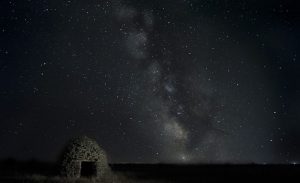
Andromeda, is a galaxy very easy to observe from the earth when the sky is under total darkness. If we look for some places away from cities and light pollution, we will be able to see it. It seems from afar like something small, the truth is that it is so big, that it can be seen by the human eye on earth.