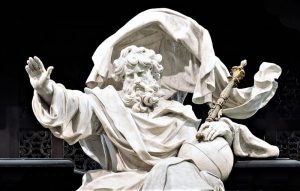
Zoroastrianism is one of the first religions that presents the internal struggle of man between the forces of good and evil, of knowledge against ignorance, life after death and frequent prayers to live with rectitude, taking care that the heart is given to Aura Mazda and that thought is not inclined towards evil.
History
In the 6th century B.C. a Persian prophet called Zoroaster or Zarathustra appeared in the lands of Iran, who preached a new dualistic religion with moral elements that would serve as an influence for future religions of western world. In this new religion, there are two gods, one called Aura Mazda or Ormuz that represents light, knowledge, justice and truth and the other known as Angra Mainyu or Ahriman (twin brother of Aura Mazda) that symbolizes evil, darkness and ignorance. Aura Mazada is accompanied by six spirits: truth, justice, order, docility, vitality and immortality.
Teachings of the prophet Zoroaster or Zarathustra went against the polytheistic religions present in the Indo-Iranian world, but little by little it was gaining strength until Prince Vishtaspa of the region of Central Asia allowed him the extension of Mazdeism in his lands. Mazdeism or Zoroastrianism was incorporated into the Persian empire after the death of the prophet and became adopted by the Achaemenid dynasty that began with Cyrus the Great.
Between the 3rd and 8th centuries, Mazdeism was the official religion of the Sasanian dynasty, but in the Hellenistic period it lost strength and faithfulness due to Greek influence. Then, with the arrival of Islam in Iran, Mazdeism’s followers gradually displaced the island of Ormuz and India to settle and continue their Mazdeist religious practices.
Today, Mazdeism has few followers in the world and its number of practitioners is decreasing compared to its beginnings in the ancient Persian world. Most of them are located in parts of Iran and India. In spite of this, this religion is still alive, and its practices are still carried out in different countries of America, Europe and Asia.
Beliefs of Zoroastrianism
Mazdeists believe that they have free will to choose between good and evil, but they know that Aura Mazda’s divine forces, which represent good, will always be above evil and overcome it.
Life after death is another of Mazda’s beliefs. This translates into the triumph of the forces of good over evil.
Characteristics of Zoroastrianism
Mazdeism has the following characteristics:
- It is a monotheistic and dualistic religion that is against polytheism.
- Its supreme God is Aura Mazda and its prophet is Zoroaster or Zarathustra.
- The supreme gods are Aura Mazada and his twin brother Angra Mainyu. The first represents good and light; and the second represents evil and darkness.
- His sacred book is called Avesta and is composed of sacred texts and 4 chants called Gathas or Gahs.
- It is believed in free will to choose good or evil and life after death.
- Followers must say their prayers (called Gahs) daily to prevent the evil one from invading them.
- No images are worshipped.
- Fire is worshipped.
- The pillars of Mazdeism are:
- Adequate thinking
- Righteousness
- Good empire
- Serenity
- Inspiration
- Integrity
- Progressive mentality
- Immortality
Sacred book of Zoroastrianism
The sacred book of Mazdeism is the Avesta. It brings together a compilation of sacred texts in the form of chants written by the prophet Zarathustra. These texts were written in the ancient languages Avestan and Gnathic.
In the Avesta are the “Gathas” or “Gahs”, which are the chants that serve as prayer, and which must be recited five times a day by the followers of Mazdeism. There are also other liturgical texts in the Avesta known as “Yasna” (a term meaning “reverence”) which are studied and read in the rites of this religion.
Zoroastrian symbols
Mazdeism has many symbols but the most representative are three:
- The Faravahar or Farohar is the most well-known icon of Mazdeism. It is a disc with wings that represents the winged Sun. In the middle of the winged sun is a man with a ring in one hand.
- The god Ahura Mazda or Ormuz (symbolizes pure good), fire, wisdom.
- The god Angra Mainyu or Ahriman (symbolizes evil), darkness, ignorance.
Rites
In Mazdeism or Zoroastrianism, prayer is one of the rites that must be carried out every day and its main objective is to watch over our heart and give it to the supreme good that Ahura Mazda represents.
- The moments of the day in which the Gahs are to be prayed are:
- From sunrise to noon (Hawan Gah)
- From midday to mid-afternoon (Rapithwin Gah)
- From mid-afternoon to dusk (Uzerin Gah)
- From dusk to midnight (Aiwiseruthrem Gah)
- From midnight until dawn (Uzerin Gah)
There are other types of prayers for other rites in Mazdeism, but these are the most frequent.
Relationship of Zoroastrianism with other religions
Zoroastrianism has an important place in the history of western religions coming from the branch of Abraham and also from the east of the Dharma branch.
The moral teachings about the fight of good and evil presented by Zoroaster in which significant elements are presented as: a good God and a Demon, the prophet, the immortality of the soul, resurrection, free will and final judgment, have had much influence on other religions such as Judaism, Christianity, Islam, among others. This can be seen in the sacred texts and practices of these religions that touch on these subjects in their beliefs and teachings even though they never claim to be linked to Mazdeism or Zoroastrianism.