Biography of Zeno of Elea
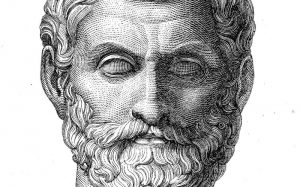
Although there is not much information regarding the biography of Zenon of Elea, we can mention among some things that he was born in Elea, a city located in the southwest of Italy. He was known as the favorite disciple of Parmenides and who accompanied him during his trip to Athens. He studied philosophy in Athens for some years and focused completely on metaphysics.
He wrote a prose book about nature. Zenon of Elea did not have a doctrine of his own, on the contrary, he spent his life defending the doctrine of his master Parmenides. He was concerned from the beginning in explaining the movement of objects since there is nothing thinkable and therefore, nothing was logical.
Zeno of Elea thought
As for Elea of Zenon thought, it was well known for its paradoxes or aporias, mainly for the one that denied the existence of the being’ movement. He tried to prove that the being had to be in a homogeneous, unique way and, therefore, he firmly thought that space was not made up of discontinuous elements, but that, on the contrary, it was made up of the cosmos or the universe, which was a single unit.
He was a defender of Parmenides of Elea thesis, Parmenides believed that what existed had neither beginning nor end, could never change and did not have many parts. It is for this reason that it is said that Zeno continues with Parmenides’ school of thought, because they affirmed that things could not be one day and then no longer be. He thought that the movement was only illusory. His thought was very oriented to combat pluralism.
Zeno of Elea arche
Zeno of Elea conceives the universe as an eternal cycle and he thinks that the universe, which begins with fire, will have to end at a certain moment and renew itself infinitely in fire which purifies everything. For him, this is the way in which the world is both, eternal and limited, continuous and repeated. Eternally the same in its eternal renewals.
Paradoxes
All Zeno’s paradoxes have been presented as a great challenge to thought and have had a decisive role within philosophy history. They are a series of paradoxes or aporias created by him. They were focused on the ongoing problem, and the relationships between space, time and movement. In total there were 40 paradoxes, of which there are still about nine or ten.
The main group is known as ” movement paradoxes “, which was focused on impossibility problem, and which was formed by: Achilles and the tortoise (a better known and famous paralogism, in which a person running fast would never be able to reach the slower runner if the latter had an advantage), the dichotomy paradox and the arrow paradox. One can also mention the paradox of plurality and continuity or argument of density.
Zeno of Elea paradoxes follow the indirect demonstration principle and are formulated and proposed in such a way, that at the beginning of each one there is the statement to be refuted. Zeno’s argument is based on a single question: can the world be divided into discrete units? This divisibility statement leads us to think whether the problem is fine or whether everything is infinitely divisible in space and time.
Some stories comment and reflect Zeno orienting his paradoxes to defend the doctrines of the master Parmenides, who said that only the infinite existed and that everything that moved was only an illusion. With his paradoxes he questioned some conceptions about the infinitely small and large. Zeno’s aporia belong to the category of false paradoxes.