Sponges characteristics
Porifera are characterized by being marine organisms with very simple taxonomic organization, so much that they do not have respiratory, circulatory and digestive systems. Their body is formed externally by pores that allow the absorption from the flow of water, a process by which it achieves its breathing, feeding, and reproduction. On the other hand, the aquatic world is fundamental for their existence, since even to move they depend on current flows.
Sponges classification
The classification of porifers is based on the presence or absence of spicules, their composition and shape.
They are classified into three groups:
- Calcareous: These sponges have their spicules made of calcium carbonate and do not have sponge fibers. They are usually small and pale in color.
- Hexactinellids: Also known as silica sponges, they have silica spicules and their appearance is glassy. They are animals from warm seas, and they live in considerable depths.
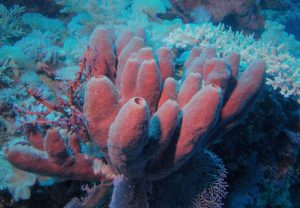
- Demosponges: They behave like sponges without spicules such as bath sponge or kitchen sponge, which maintain their shape thanks to sponge fibers, a protein close to silk. This is the type in which most sponges are found. They are usually bright colors such as red, green, and blue because of the granules found on the inside of the sponge cells.
Sponges reproduction
 The reproduction of porifera can be achieved in two different ways: asexually, by germination from the fragmentation of their own organism, thus giving birth to a new organism; and sexually through the expulsion of eggs in the water.
In fragmentation, part of the sponge separates from the rest of the body and it regenerates the missing parts, creating a new organism. This is achieved from the simplicity of its taxonomy.
After the oviparous species expels the spermatozoa to the aquatic environment and these manage to enter through the pores in another sponge of viviparous origin, fertilization occurs until giving life to a new organism.
Sponges feeding
This species has a diet based on microscopic particles, bacteria, protozoa and green algae or cyanobacteria. There may also be some carnivorous species that feed on tiny crustaceans.
Due to the particularity of its food, and not having mouths, this species feeds through pores located on the outside of its body, with which they can capture water from their habitat. Water passes through a filter where it absorbs the necessary nutrients for its diet. This process is fundamental for the purification of marine waters, because even the smallest sponges could filter around 20 liters a day.
The sponge captures microorganisms and particles, absorbs them through the pores, achieving 80% of its food.
Breathing
Sponges or porifers have pores on the outside of their bodies, allowing them to feed and breathe by absorbing excessive amounts of water.
During the water absorption, sponges obtain oxygen dissolved in it. Sponges have the ability to purify carbon dioxide and ammonia residues, serving as a natural filter to its habitat. From this process, the necessary oxygen to live is obtained.
This system is not classified within digestive, respiratory and/or circulatory systems of the animals with heart, since its process through water absorption fulfills the functionality of these three.
Habitat
The sponges, being aquatic organisms, live mostly in ocean areas, ranging from the coast to seven thousand meters deep. Approximately 150 species of sponges are naturally freshwater.
Due to their motor limitation, since they do not manage to move on their own, but are dragged by water currents, they live stuck to the bottom, just like a plant. Some of these species, when they get fertilized with others, form a colony, but when they don’t get fertilized, they stay solitary.
Examples
Some of the best-known poriferous animals include the family Spongiidae to the popularly called horse sponge. Another example of the Petrossidae family is the barrel sponge.