The Pharisees did not like Jesus because according to his customs and laws, he did not comply with them. Jesus, on the other hand, always answered their questions and bad intentions, exposing them as liars or false before God’s law. For this reason, they did everything they could to have Jesus be judged to death, and it is to them that his death is attributed.
Characteristics of the Pharisees
Of the most well-known characteristics of the Pharisees, the following can be mentioned:
- They followed the Jewish law.
- They were concerned about what the people said about them.
- They were not priests.
- They were murmurers and hypocrites.
- People were educated, knowledgeable about the law and the prophets.
- They were mostly merchants and liked money.
- They did not believe in the men of God.
- They could not marry pagans.
- They believed that God controlled things.
- They believed in the resurrection of the dead.
- They believed in an afterlife.
- They believed in the existence of angels and demons.
- They felt superior to nations that had pagan religions.
Origin
The Pharisees originated as a social group between 587 and 536 BC. In these years, Jewish people were held captive by Babylon.
Between 167 and 165 B.C, they were formed as a religious sect during the revolt of the Maccabees against the Seleucid invaders and had greater strength in the reign of Juan Hircanio in 135 B.C.
History of the Pharisees
The history of the Pharisees begins in the second century B.C. with a group of Jewish people who wished to separate themselves from those who did not follow God’s law and form a sect that represented the religious and political authority of the Jewish community. In their beginnings and for many years they were respected by Israel.
They appear after the Jews leave Assyria for Jerusalem and encourage the people to follow the law. They were not priests but dedicated themselves to the worship of God’s law.
One of their important contributions was to compile a very important document called The Mishna, which referred to the continuation of Judaism after the destruction of Solomon’s Tempo.
Over the years, the Pharisees expanded the laws of God with their interpretations deforming the original laws. For this reason, the Pharisees were strongly criticized by Jesus, who made them look like hypocrites and liars by complying with God’s law.
Beliefs
The Pharisees had a doctrine based on soul immortality, where good people were rewarded, and bad people were sent to hell.
- Among their beliefs are the following:
- They believed in the resurrection of souls and in eternal life.
- They believed in human freedom over destiny.
- They believe in the punishments and rewards of the Eternal.
- They believed in heaven and hell.
- Resurrection is understood as the passage to eternity.
- They believed in obedience to their traditions such as rites, ceremonies, prayers, others.
- They accepted divorce.
Traditions
Among the traditions most followed by the Pharisees were the following:
- They fasted twice a week.
- They complied with the rite of the tithe.
- They kept the Sabbath.
- They gave alms
Clothing
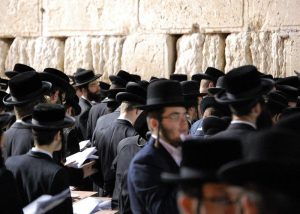
The Pharisees wore luxurious clothes with blue stripes on the corners of their cloak and four fringed ends. A garment worn by this Jewish sect was the tallit or prayer shawl.
It is said that the fringes and the four points were to remember the laws of Moses and the four letters of the name of God.
The Pharisees also carried with them a small metal box or parchment strips tied to the hand or forehead with scripture passages referring to the Passover and Moses’ redemption.
Why the Pharisees criticized Jesus
The Pharisees criticized the figure of Jesus because they thought that Christ did not follow the law as they carried it. They said that Jesus didn’t keep the Sabbath, didn’t do the handwashing, and Jesus always met with sinners and tax collectors. Others falsely accused Jesus of casting out demons through the demon governor.
Jesus’ disciples were also criticized by the Pharisees for not complying with the traditional handwashing, but Jesus showed them that this Law did not come from God but from man and that they were violators of God’s Law.
The Pharisees were always against Jesus and made every effort to bring them to death. They were the ones who preferred the freedom of Barabbas and the death of Jesus before Pontius Pilate, and they were the ones who asked the Romans to secure Jesus’ tomb so that his body would not be stolen.
Questions from the Pharisees to Jesus
The Pharisees asked Jesus questions to tempt him, yet Jesus always knew how to answer their questions.
Among the questions that the Pharisees asked Jesus, we will mention the three best known. These are:
- Tax question: “Is it lawful to pay tribute to Caesar or not?” (Matthew 22:15-17). To this question Jesus answers: “Give to Caesar what is Caesar’s, and to God what is God’s.” (Matthew 22:15-17). (Matthew 22:18-21)
- Question about the Law: “What is the great commandment in the law?” (Matthew 22:34-36). To this question Jesus answers: “You shall love the Lord your God with all your heart, and with all your soul, and with all your mind. This is the first and great commandment. And the second is like it: You shall love your neighbor as yourself. On these two commandments depend all the law and the prophets.”
- He asks why he ate with sinners: “Why do you eat and drink with tax collectors and sinners? (Luke 5:29-32). To this question Jesus answered: “Those who are healthy have no need of a doctor, but those who are sick” (Luke 5:29-32). (Luke 5:29-32)
Phrases
Currently, there are some phrases of popular use that refer to the Pharisees but in a negative way. Some of these are:
- “To make fat broth to scribes and Pharisees”. (Anonymous)
- “If thou wilt be righteous, hate no man: the righteousness of them that hate is the wrath of the Pharisees”. (Silvio Pellicone)
- “But even the Pharisees and scribes take advantage of such adversaries, they must have possessed some courage to be so indecently hated”. (Nietzsche)