What happened in the Mesozoic era
During the Mesozoic period, there were major changes in geological and biological transition. During this era, continents began to move and separate from the Pangea. There was a process of modernization of different forms of life that occupied the Earth, and one reason for this was the disappearance of many types of organisms. Three of the five largest and most historic mass extinctions of the Earth occurred, which in turn, are related to the Mesozoic stage.
As the continents separated, marine sediments began to accumulate in large channels that now form the Pacific region, the eastern coasts of North America and the Gulf of Mexico. The orogeny began to occur on the western margins of North and South America. There were changes in equator and pole temperatures as the earth was warmer than it is today. Evidence has been discovered that the global cooling was the result of the impact of an asteroid against the Yucatan Peninsula, the great volcanic activity and the blocking effects of the sun due to the dust that was thrown into the atmosphere.
Characteristics of the Mesozoic era
- It was known as the time of the dinosaurs.
- Botanically, it was known as the age of the cycads.
- It began in the Triassic period and ended in the Cretaceous period.
- The atmosphere was warmer than it is today, and the polar zones did not yet exist.
- It began with the greatest extinction in Earth’s history, which took place 252 million years ago and resulted in the death of 96% of marine life and 70% of terrestrial life.
- The emergence of dinosaurs began with the extinction of their predecessors at the end of the Triassic Period, the Saurian arches.
Periods
The periods of the Mesozoic era are three:
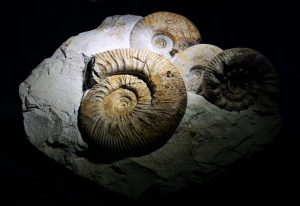
- Triassic: In this period the first ammonoids arose and dinosaurs were born, which at the beginning were bipeds, carnivores and small size. There was the massive extinction of the Permian Jurassic and the first mammals began to evolve, appearing in this period due to climate changes that arose. The Pangea was formed, and by the end of the period, the dinosaurs had evolved into the vertebrates that dominated the entire planet. Pangea began to separate.
- Cretaceous: It was divided into two: lower and upper Cretaceous. It marked the end of the previous era and produced one of the greatest extinctions, in which many of the dinosaurs disappeared along with many invertebrates. The evolution was based on plants with flowers, mammals and birds. It is believed that extinction was caused by climate and atmospheric causes, plus the fall of a large asteroid that killed many dinosaurs. The Andes Mountain Range began to form.
- Jurassic: It was the main era for dinosaurs. There was a hegemony of the great dinosaurs. By this time the Pangea had already been divided into two large masses separated by the Thetis sea.
Weather
The climate can be studied depending on the period, therefore, in the Triassic period, it was hot and very dry, giving rise to deserts, it was very seasonal and had very hot summers and quite cold winters. During the Cretaceous period, there are few data regarding climate, but it is believed that the high levels of carbon dioxide produced a temperature change, which rose enormously giving way to deserts formation. Jurassic climate was warmer and more humid, with the presence of tropical and subtropical belts that formed new plants.
Animals of the Mesozoic era
The first mammals and birds appeared. These birds were descendants of the dinosaurs. Some dinosaurs, in order to conquer the air, began to transform their front extremities into wings in order to fly, and their body began to cover itself with feathers to offer them protection. During the Cretaceous period, animals such as hadrosaurs, iguanodons, ornithopters, pachycephalosaurs, all of them of enormous size, appeared. In the Jurassic period the first amphibians and reptiles appeared, and the predators became bigger adapting their forms of survival by means of hunting. The first birds also appeared.
Dinosaurs
They were the species that populated the earth millions of years ago. Reptiles of prehistoric origin of different sizes that populated and ruled the Mesozoic era. Some of them were bipeds, others had claws and others were quadrupeds. They were slow, fast, enormous in size, and some species were smaller in size. They were predatory and fast. They did not crawl but could walk and could be carnivores or herbivores.
Plants
During the Mesozoic era, plants did not actually undergo major changes or extinctions. They were adapted to the type of dry and warm climate and were mainly cycads. The ferns dominated the wettest areas along with the cycads, which were very similar to the palms and pines of today. In the last period there was the formation of abundant vegetation.