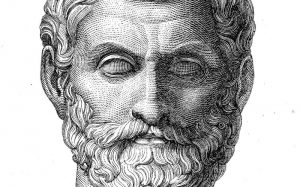
Biography of Heraclitus
Heraclitus lived in the city of Ephesus, an important place on the Ionian coast of Asia Minor, considered the cradle of philosophy. Apparently, he came from an aristocratic family, although not much is known about his life other than what can be deduced from his own statements, since all the ancient biographies of him consist of nothing more than inferences or imaginary constructions based on his sayings. He used the nickname “the dark one” because of the enigmatic character of his style. He was against Athens democracy and was part of a sympathetic group with the Persian king Darius I the Great.
Thought of Heraclitus
Heraclitus thought that the vast majority of human beings lacked understanding. For him, most people walk through life without even understanding what was going on with them or their lives. However, he also believed that the experience of words and deeds was able to enlighten those who were receptive to their meaning. On the one hand, he praised the sensitive experience, preferring the things he had seen, heard or experienced, and on the other, he considered the eyes to be the bad witnesses of men if they had barbaric souls. A barbarian is one who does not speak Greek. Therefore, he believed that, although sensory experience was necessary for understanding, if the correct language was not known, there was no way to interpret the information provided by the senses. He also considered that fire had a constituent role to things and was the reason for all the changes that occurred in nature.
Contributions
His contributions to philosophy and science created a precedent for Greek philosophical thought, better known as Socratic thought. Some of their contributions were:
- He considered fire as a primordial element, as the essence and origin of everything that existed. He considered that fire was never extinguished and that this fire went along with the rhythm of nature.
- He said that all phenomena occurring in nature are in constant motion and change. Nothing is inert or lasts forever. Movement and change allow the balance of the universe.
- He believed that nature’s and man’s phenomena were the result of being opposed to reality. For him, a state could not be experienced if one had not previously experienced
- He founded the principle of causality by saying that everything that exists has a cause and that nothing could be a cause of itself.
- He considered that the logos were always present but could become incomprehensible to men.
Fragments
Some of his fragments are:
- Fragment 2: Being this reason eternally true, men are born incapable of understanding it before hearing it and after having heard it. Since everything happens according to this reason, they resemble the inexperienced, by experiencing words and works such as I develop them, analyzing each thing according to its nature and explaining how it really is. But what they do awake is hidden from other men, just as they forget what they do asleep.
- Fragment 13: Of what there is sight, hearing, science, that I honor, first of all.
- Fragment 20: This world, the same for all, was not made by any of the gods or men, but it has been eternally and is and will be an eternally living fire, which is lit according to measurement and extinguished according to measurement.
Arche of Heraclitus
For Heraclitus the arche is the fire, which is a substance generating the beginning of things, of the cosmos. The universe was an eternal fire that was lit and extinguished by the logo, with which the order and harmony of the cosmos could be given, and of laws that determined unity and struggle.
Works of Heraclitus
Apparently Heraclitus could only write a book titled “Of Nature”, of which there are three subdivisions:
- About the Universe
- Politics
- Theology
Phrases
- The sun is new every day.
- You cannot tread the same river twice, because it is not the same river and he is not the same man.
- Nothing resists except change.
- Eyes and ears are bad witnesses for people if they have uncultivated souls.
- Abundance of knowledge does not teach men to be wise.
- All have the possibility of being wise, but their contemporaries live as if asleep.
- God is day and night, winter and summer, war and peace, satiety and hunger.