About geological ages
The geological ages of the earth are four and are as follows:
- Archaic Age
- Precambrian Age
- Paleozoic Age
- Mesozoic Age
- Cenozoic Age
Classification of geological ages
The history of the earth is classified into five important stages, each with a different number of years. This classification is as follows:
- Archaic Age: located in the first millions of years of the earth where it was considered to be a sphere full of gases very similar to those that form the sun and from which the planets were formed. According to the theory, the earth cooled and the gases were transformed into liquids, these liquids then cooled further and solidified to form the first rocks. From them came vapors that formed the clouds and the atmosphere. The seas and life The rains that were deposited in the crust gave origin to the primitive seas and from the bottom of the planet arose the magma that formed volcanoes.
- Precambrian Age: in this era the first manifestations of life took place, they were unicellular beings very similar to bacteria. Some fossils of this era are rudimentary marine impressions. The cooling of the planet continued and the volcanic explosions decreased generating iron, silver and copper. Sedimentary rocks formed. It is also known as the protozoic age or the era of elemental life and it is considered that it lasted approximately 650 million years, sponges, corals and plants with roots appeared with it.
- Paleozoic Era: at this time, fish and ferns emerged, and it was a stage of relative tranquility. The oceans covered large portions of the planet and erosion began to play an important role. The limestone rocks were formed, there were marine animals with shells and on the coasts of the seas, a large amount of sand settled. There was a great multiplication of insects. The climate was hot, there was arborescent forest formation and the first vertebrate animals arose that could live both on land and in the sea. It lasted approximately 360 million years.
Characteristics
Among the main characteristics that we can mention about geological ages are the following:
- They are units of temporal chronology that represent the time that has passed since the beginning of the planet.
- The passage from one era to the other is defined by massive extinction events of both plants and animals.
- Its foundation are the rocks and fossils that have been found around the earth.
- They represent the different modifications that the earth has undergone over the years.
What are the geological ages for?
The geological ages serve to determine the epoch in which the rocks were formed, the strata and the step and transformation that the living beings had until reaching their present state. The study of climate, oceans and continents is possible through the study of geological ages.
History
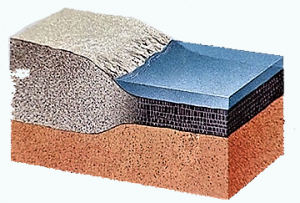
In ancient Greece, Aristotle observed that fossils of seashells on the rocks resembled those found on beaches. He concluded that the fossils in the rocks were made up of living animals and reasoned that the positions of land and sea had changed over long periods of time. Leonardo da Vinci agreed with Aristotle’s interpretation that fossils represented the remains of ancient life. Persian geologist Avicenna and 13th-century Dominican bishop Albert the Great extended Aristotle’s explanation of a theory of a petrifying fluid. At the end of the 17th century, Nicholas Steno pronounced the principles of geological time scales. Steno argued that layers of rock or strata were placed in succession, each representing a “portion” of time. He also formulated the law of superposition, which states that any given stratum is probably older than the previous ones and younger than those below.