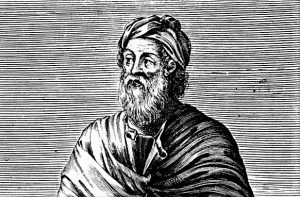
Biography of Epicurus
Epicurus was born in February 341 B.C. on the island of Samos, in the Aegean Sea. His parents were Neocles and Chaerestrate, who were citizens of Athens, but who decided to emigrate to the Athenian settlement of Samos. As a child, he studied philosophy with the Platonic teacher and at the age of 18, he went to Athens to perform his military service for two years. Meanwhile, his parents were forced to move from Samos to Colophon in Ionia after Alexander the Great’s death, where Epicurus joined his family. He taught for a couple of years at Mitilene on the island of Lesbos, but apparently caused riots and was forced to leave.
He then founded a school in Lampsacus before returning to Athens in 306 B.C. He founded The Garden in Athens, a school that served as the meeting place for his epicurean school. It was the first of the ancient Greek philosophical schools to admit women. Emphasizing friendship and freedom as important ingredients of happiness, the school resembled in many ways a community of friends who lived together, though Epicurus also instituted a hierarchical system of levels among his followers and made them swear upon its basic principles. He never married and had no children. He suffered from kidney stones and finally died in 270 B.C. at the age of 72 as a result of these stones and a case of dysentery.
Thought of Epicurus
His thought was mainly based on his metaphysics which was materialistic, his epistemology which was based on empiricism and his hedonistic ethics. Epicurus’ philosophy was mainly based on the theory that the moral distinction between good and evil is derived from what is good or pleasant, and what is bad or painful. Therefore, moral reasoning is a matter of calculating the benefits and costs in terms of pleasure and pain. His main objective was actually the absence of pain and suffering because he thought that when a person did not suffer pain, no pleasure was needed and the person entered a state of perfect peace of mind, which is the ultimate goal of human life. Therefore, he emphasized minimizing the harm and maximizing the happiness of oneself and others.
Contributions
Among their main contributions we mention the following:
- He created the word ataraxia, which meant that reason was in charge of our happiness.
- He founded the empiricist theory of knowledge through an atomist physics in which he took inspiration from Leucippus and Democritus.
- He said that men should reject any teaching based on fears and superstitions, because there was no reason to be afraid of gods.
- He founded the ethics of Reciprocity or better known as the Golden Rule, which means “to treat others as you would like to be treated,” possibly the basis of the modern concept of human rights.
- He introduced into Greek thought the fundamental human egalitarianism that gave way to the admission of women and slaves into schools.
- It introduced the idea of a social contract since justice comes from a joint agreement not to harm each other. Theory that later gave rise to utilitarianism.
Happiness according to Epicurus
Epicurus believed that happiness was living in a state of continuous pleasure. These pleasures were natural and necessary (such as basic physical needs, eating, shelter, security), natural and unnecessary (conversations and arts), and unnatural and unnecessary (fame, political power, or prestige). He thought that the greatest obstacles to happiness were fear of dying, fear of the future, and fear of divine wrath, which could be removed if nature was known. Happiness was something that could be achieved when natural needs were satisfied and that was the absence of physical pain. I also thought that not all forms of pleasure led to happiness because sensual pleasures were not part of happiness.
Works of Epicurus
He wrote more than 300 manuscripts and 37 treatises on physics. His works were basically theming of love, justice and gods. Only three of his main letters have been saved:
- Letter to Herodotus, which spoke about gnoseology and physics.
- Letter to Phytocles, explaining cosmology, astronomy and meteorology.
- Letter to Meneceo, it was merely an ethical letter.
Phrases
Some of Epicurus’ best phrases are:
- The art of living well and the art of dying well are one.
- It is impossible to live a pleasant life without living wisely, well and fairly. And it is impossible to live wisely, well and justly without living a pleasant life.
- Don’t spoil what you have by wishing for what you don’t have; remember that what you have now was once things that you only wanted.
- If God had listened to man’s prayers, all would have perished quickly, because they always pray for the evil of others.
- Death does not concern us, because as long as we exist, death is not here. And when I arrived, we no longer exist.