What happened during the Cenozoic era
During this era, the Atlantic Ocean widened forming the Atlantic mountain range, countries like India had great shocks until they came to form the Himalayan mountains, at the same time, African tectonic plate made its movements towards Europe forming the Alps, and in North America, the Rocky mountains were formed by the same processes. Cenozoic rocks develop in the continents, especially in lowland plains and acquired more hardness due to high pressure caused by deep burial, chemical diagenesis, and high temperatures. Sedimentary rocks predominated during the Cenozoic, and more than half of the world’s oil is located in them.
Characteristics of the Cenozoic era
The main features that stood out during Cenozoic era are:
- Mammals evolved and diversified.
- There was an extension of the fauna along the whole land.
- The Atlantic Ocean
- It gave rise to the great mountain ranges of the world.
- The first hominids
- Polar ice caps were formed.
- The human species
Periods of the Cenozoic era
The Cenozoic era is divided into two periods called the Tertiary and Quaternary periods, which at the same time are subdivided into different periods.
Tertiary period
It is the first period and the forms of life both on land and sea were similar to those of the present day. Dinosaurs had disappeared and mammals and birds dominated the land. There were marsupials, herbivorous and insectivorous animals, ruminants and whales. This period is subdivided into five epochs:
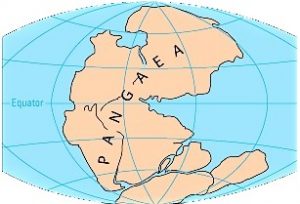
- Paleocene: There was a planet cooling and the Pangea finished dividing. Greenland moved away from North America and many bird species emerged along with angiosperms.
- Eocene: Large mountain ranges arose that provoked orogeny. Mammals became the most important animals and the first horses appeared. Primates were born and some mammals adapted to marine life.
- Oligocene: Tectonic plates continued to collide, and the Mediterranean was formed. The mountains of the Himalayas and Alps were formed. There were large numbers of rodents and mammals.
- Miocene: The Alps, Himalayas and mountain ranges of America were formed. An Antarctic ice cap was created causing the climate to be cooler outside Antarctica. The prairies originated and the fauna evolved.
- Pliocene: Mammals reached their apogee and spread, the climate was cold and dry, and hominids appeared with different species such as Australopithecines and Homo habilis / homo erectus, ancestors of Homo sapiens.
Quaternary period
This period is divided into two different stages:
- Pleistocene: also called the ice age because it extended over a quarter of the earth’s surface, in places where there was no ice, flora and fauna were the same as in the previous period called Pliocene. By the end of the period, many mammals had become extinct.
- Holocene: in this period the ice disappeared, giving rise to vast land surfaces and widening the continental shelf. The climate was warm with abundant flora and fauna. Humans began to unite in groups and began to use hunting and agriculture to survive, leaving life abandoned as nomads.
Weather
Cenozoic was considered to be a cooling period that lasted a long time. At the beginning of the Cenozoic period, many particles blocked solar radiation. After Australia completely separated from Antarctica during the Oligocene period, the climate cooled considerably due to the appearance of the Antarctic Circumpolar Current which produced an immense cooling of the Antarctic Ocean. Then, during the Miocene, there was a slight warming due to the liberation of hydrates that released carbon dioxide. The climate cooled down and the first glaciations appeared.
Cenozoic era animals
At this stage, dinosaurs and many species of the time became extinct. It is supposed that this happened through the impact of a large meteorite that raised large amounts of dust, preventing light from reaching plants and producing serious alterations in the food chain, resulting in the extinction of 75% of life. Mammals took advantage of the situation and reproduced, thus dominating the land.
Plants
The flora of the Cenozoic era was characterized by the development of phanerogam-type plants and flanked trees. There was a great variety of plants and trees that dominated the landscapes. These plants were angiosperms and were easily developed and adapted to the time conditions. Fruit trees, palms and legumes could be found in the Cenozoic era.