Characteristics
The main characteristics of meteorites are as follows:
- They are irregularly shaped masses, can be angular or square and generally have rounded corners.
- Some of them will be marked on their surface with pits that are commonly called fingerprints.
- Iron in meteorites is always alloyed with nickel.
- Sometimes the number of falling meteors increases dramatically, and these events are called meteor showers.
- Those on Earth are about the size of a fist, but some are larger than a building.
- The word meteor means “sky phenomenon” and is used to describe the light produced when a fragment of matter from space enters the atmosphere.
- To get into the atmosphere at an average speed of about 10 and 70 km/s.
History
In reality, meteorites did not attract much serious scientific attention during the first centuries of the Enlightenment as they were explained as atmospheric processes, hailstorms condensed in the clouds, or land rocks struck by lightning, or that were volcanic rocks, thrown violently during major eruptions. No one thought of meteorites as space rocks. In the early 19th century, scientists shared Isaac Newton’s view that there could be no small objects in interplanetary space.
At the end of the 18th century there was a change, and in 1772, during one of the German naturalist journeys Peter Pallas, a huge mass of iron near Krasnoyarsk was examined, which had fallen from the sky. It caught his attention because it was covered with a black crust, and there were many translucent olivine crystals in its matrix. Unconsciously, he had discovered a new type of meteorite, a kind of stony iron meteorite that would later be named after him: the pallasites.
On December 13, 1795, a 25 kg stone fell in Wold Cottage, England during daylight, contradicting the explanations for a meteorite formation. This meteorite was analyzed by Edward Howard, who discovered that it contained grains of iron and nickel metal, with a composition similar to the iron meteorites described in Chladni’s book. In 1802, Howard published the results of his analysis and conclusions regarding the Wold Cottage incident, convincing a growing number of scientists that meteorites actually represent extraterrestrial matter falling from the sky.
The study and analysis of meteorites began in 1768 when one of them fell in Lucé, France. After the fall, the French Academy of Sciences sent a group of scientists to study the meteorite.
Meteorite types
There are three basic types of meteorites, iron meteorites, stone meteorites and stone meteorites. Each is explained below.
- Iron or metallic meteorites: formed from solid nickel iron. Because of the iron’s strength, most of the individual meteorites are iron and many of the craters were formed by this type of meteorites. They show a pattern when recorded with chemicals because of the different nickel iron ores that make them up.
- Stony meteors: they are made of stone almost entirely and are the most common, about 10% of them fall to the ground. Within this group we can find, for example, stone meteorites, chondrites, achondrites and planetary meteorites that are also chondrites but have unique origins.
- Stony-metallic meteorites: they are formed from a mixture of iron, nickel and some silicate They are divided into two groups, the pallasites and the mesosiderites.
Components
Depending on the type of meteorite, these can be composed of silicate, aerolite or lithium, many of them have iron and nickel, metallic and rocky materials.
How is a meteorite different from an asteroid?
The asteroid is a rocky, carbonaceous or metallic body, smaller in size than a planet and superior to that of a meteoroid. The meteorite is a rocky body that reaches the surface of a planet, leaving a wake of light.
Meteorites falling on the ground
The largest that has fallen and been identified on Earth was found in 1920 in Namibia and was called the Hoba meteorite. It was 2.7 meters wide and its approximate weight was about 60 tons and was composed of iron and nickel.
It is believed that a very large asteroid impact 65 million years ago, which created the 300 km wide Chicxulub crater in the Yucatan Peninsula, contributed to the extinction of approximately 75% of marine and terrestrial animals on land at the time, including dinosaurs.
One of the most intact craters is the Barringer Meteorite crater in Arizona, approximately 1 kilometer in diameter, formed by the impact of iron metal meteorite and nickel approximately 50 meters in diameter. It is 50,000 years old and so well preserved that it has been used to study impact processes. Since this feature was recognized as an impact crater in the 1920s, nearly 170 impact craters have been identified on Earth.
Meteorite fragments
Many meteorite fragments have been found around the world and are usually sold in large sums of money as some are even millions of years old.
Curiosities
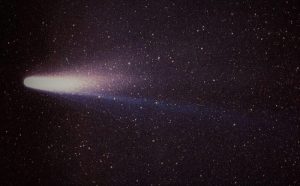
Meteor showers usually bear the name of a star or constellation that is near where meteors appear in the sky. Perhaps the most famous are the Perseids, which peak around August 12 each year. Each Perseids meteorite is a small piece of the Swift-Tuttle comet, which sways by the Sun every 135 years.